


Item No.: 1039
Name: Large Wucai Dish with a Judicial Scene, Kangxi Period
Period: Qing dynasty, Kangxi reign
Rim diameter: 44.8 cm
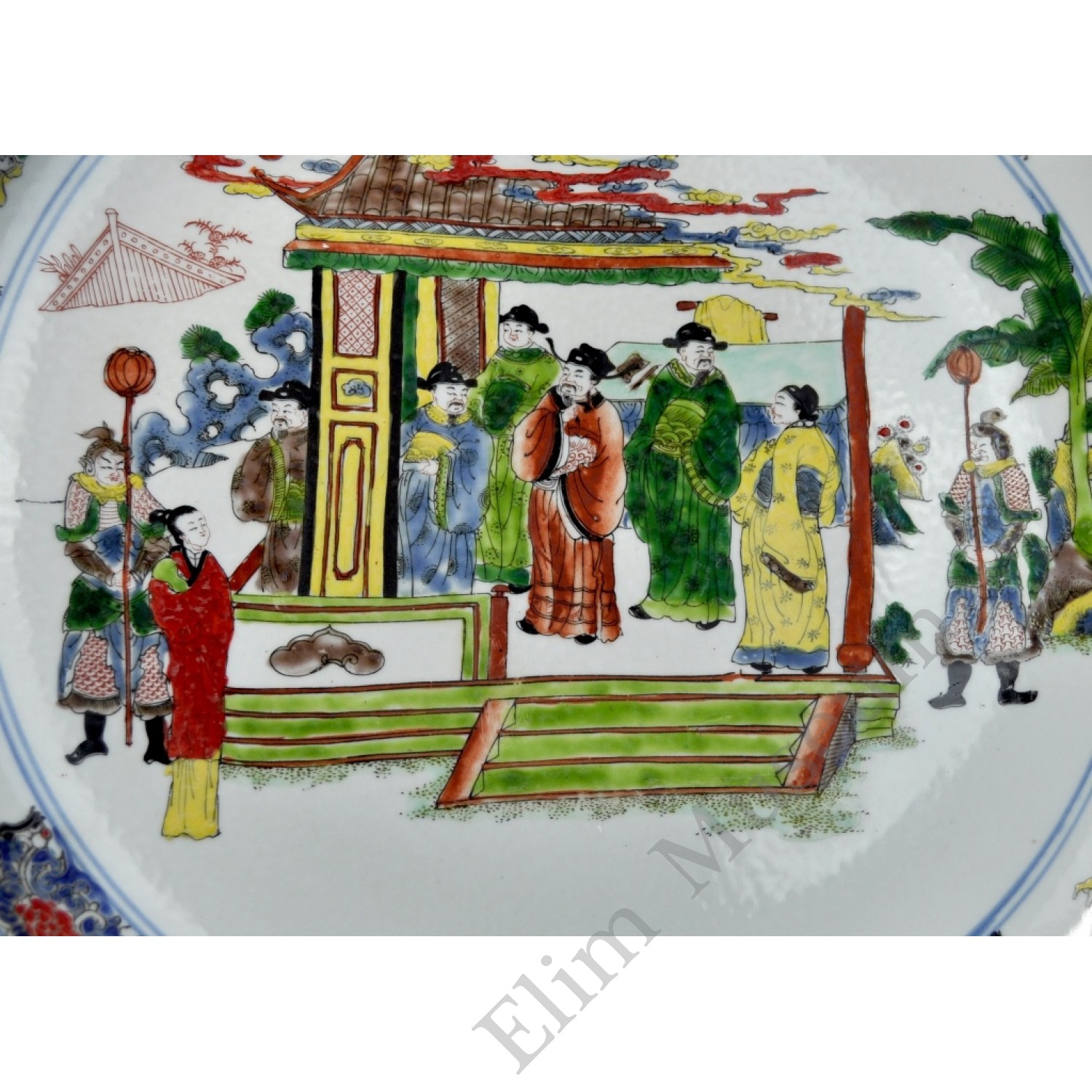
This large Kangxi-period wucai dish, approximately forty-five centimetres in diameter, depicts a judicial scene that may involve imperial authority. Underglaze-blue concentric lines divide the decoration around the rim into bands, where red blossoms and green foliage alternate with diaper-patterned panels and miscellaneous auspicious emblems, framing the narrative at the centre. Red, green, yellow, blue, and brown create a vivid palette. The hall, columns, balustrades, and steps establish a clearly articulated space, directing the viewer’s attention to the subtle interactions between the officials above and the woman below.
Several figures in official robes of different colours gather in the hall. Some turn to converse, while others exchange smiling glances, their demeanour notably relaxed. At the centre stands an official in a reddish-brown robe, one hand resting on his belt and the other stroking his beard. His composed expression suggests that he has already formed a confident judgment about the case before him. Guards holding long-handled ceremonial maces stand on either side, lending the scene a solemn, ceremonial atmosphere. With economical yet fine, assured lines, the painter delineates brows, eyes, beards, and gestures, giving each figure a distinct personality despite their similar official attire.
In striking contrast to those in the hall is the woman in red at the lower left, outside the steps. Standing beside a guard, she appears to be a party to the case who has been brought before the officials to await questioning or judgment. Her arms are folded across her chest, her lips tightly closed, and her gaze directed sideways and upward toward the hall. Her expression combines wariness and tension with a measure of pride and defiance. She neither bows her head to beg for mercy nor shows any sign of submission. Her vivid red clothing and isolated position make her an especially arresting presence within the composition.
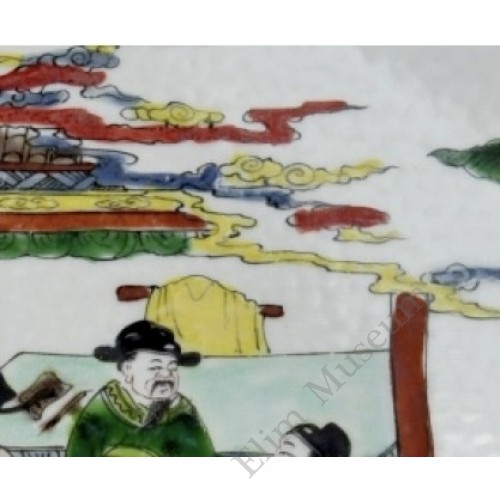
Particularly noteworthy are the multicoloured auspicious clouds drifting above the hall and a yellow textile, possibly a dragon robe, draped over the back of the central chair. What appears to be the outline of a collar can be discerned along its upper edge. Placed in such a prominent position, this robe, together with the clouds, officials, and mace-bearing guards, may suggest that the crown prince—or even the emperor himself—had taken part in the proceedings.
We cannot yet determine whether the scene depicted on this dish relates to a specific case from the Qing dynasty. What is remarkable is that the artist’s perceptive observation and subtle portrayal of the figures’ circumstances lend the work something of the character of “critical realism.” On the one hand, it presents imperial majesty and the ideal of impartial judgment; on the other, the red-robed woman’s refusal to yield readily preserves a sense of individual dignity and resolve in the face of authority. The scene also prompts a troubling reflection: without imperial intervention, how many injustices suffered by ordinary people might have remained forever unredressed?