
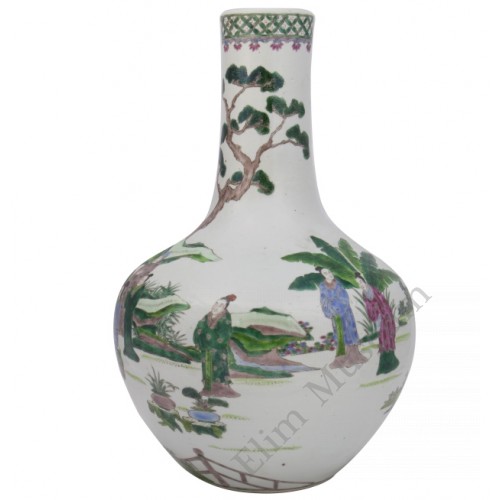
Collection no.: 1038
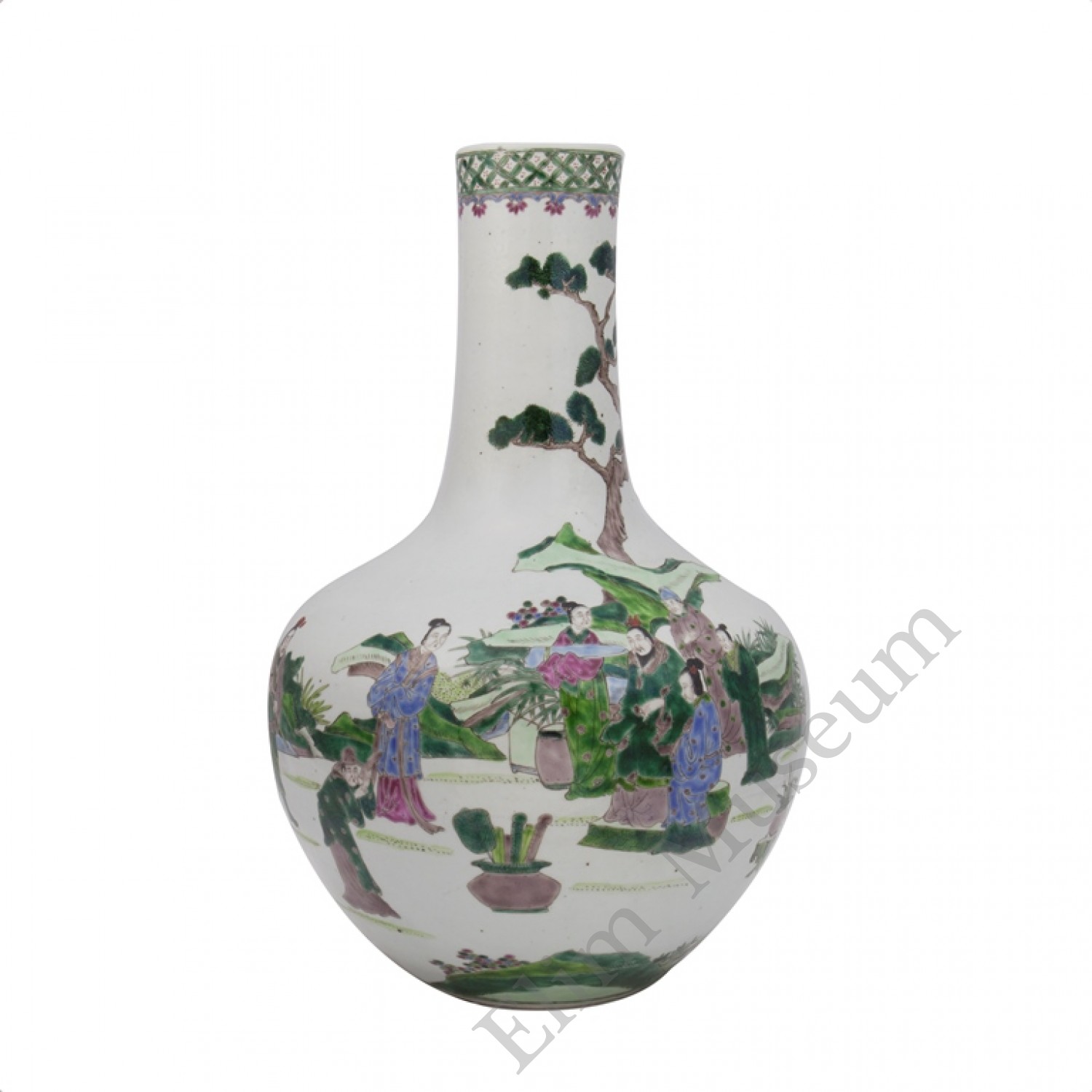
Name: Qing Dynasty Wucai Vase with Scenes from Selling Relief Grain in Chenzhou
Date: Early Qing dynasty
Body diameter: 21.2 cm
Selling Relief Grain in Chenzhou originated as a Yuan-dynasty zaju play of the thirteenth to fourteenth centuries. Originally entitled Bao the Court Attendant Oversees the Sale of Grain in Chenzhou, it was included in Selected Yuan Plays, published during the Wanli reign of the Ming dynasty. Set in the Northern Song dynasty, the play tells of a drought in Chenzhou. Liu Dezhong and Yang Jinwu—the son and son-in-law of the powerful Liu Yanei—are sent by imperial order to open the granaries and sell relief grain. Instead, they exploit the relief operation for personal gain, raising grain prices and cheating the people with undersized grain measures and overweight scales. They also kill Old Zhang, who has come to buy grain, with an imperially bestowed purple-gold hammer. His son, Xiao Piegu, travels to the capital to seek justice and encounters Bao Zheng. Commissioned by the emperor to investigate, Bao uncovers the truth in disguise, punishes the corrupt officials, and secures justice for the people.
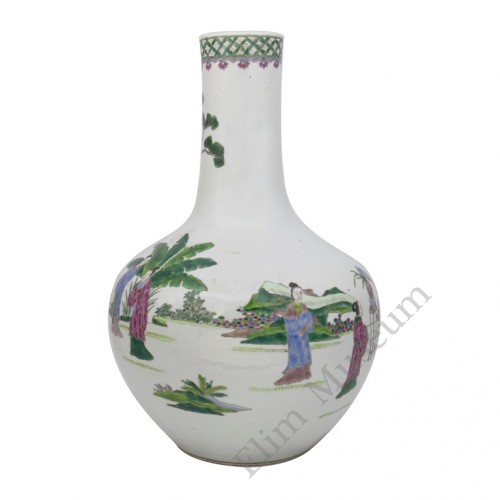
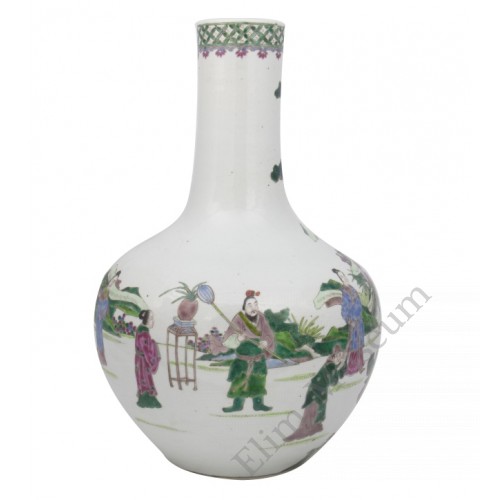
The two narrative scenes on this wucai vase may be read as episodes from Acts Three and Four of the play. In the first, Bao Zheng disguises himself as an elderly farmer to investigate incognito, only to be strung up in an old scholar tree by Liu Dezhong and Yang Jinwu at the Official Reception Pavilion. The second depicts a confrontation in the Chenzhou government courtroom: after ordering Liu Dezhong's execution and allowing Xiao Piegu to kill Yang Jinwu with a melon-shaped mace, Bao faces Liu Yanei, who arrives bearing an imperial decree intended to save his son and son-in-law.
The painted decoration includes numerous objects and figures closely associated with the plot: the old scholar tree, the melon-shaped mace, Bao Zheng's imperial sword of authority, documents and registers, and an imperial decree. The figures may be identified as a white-faced Bao Zheng, his four personal guards, the plaintiff Xiao Piegu, the courtesan Wang Fenlian appearing as a witness, and Liu Yanei holding the imperial decree. These mutually reinforcing details provide clues for interpreting the scenes through the story of Selling Relief Grain in Chenzhou.
Works celebrating upright officials who punish corruption and protect the people are plentiful in traditional Chinese literature and drama. Stories and plays centered on Bao Zheng were particularly widespread. Porcelain decorated with such subjects, however, is less commonly encountered. Two features of this vase are especially noteworthy. First, Bao appears with a white face, possibly reflecting the episode in which he investigates in disguise. Second, the sword symbolizing his imperially granted authority is a prominent prop. These features differ from the familiar later image of the black-faced Judge Bao and his dragon-headed execution device, and may preserve certain characteristics of early Yuan-dynasty Bao plays.
Made in the early Qing dynasty, the vase's choice of subject may be understood against the gradual restoration of social order and the court's advocacy of administrative reform during the Kangxi reign. It may also reflect the people's shared hopes, after the warfare accompanying the dynastic transition, for an enlightened sovereign, honest officials, and a peaceful, secure livelihood.