-1500x1500-product_popup.jpg)
-500x500-product_thumb.jpg "1033 Long-Necked Famille-Rose Vase with Figures from the Wushuangpu, Bearing a Tongzhi Reign Mark")
-500x500-product_thumb.jpg "1033 Long-Necked Famille-Rose Vase with Figures from the Wushuangpu, Bearing a Tongzhi Reign Mark")
-500x500-product_thumb.jpg "1033 Long-Necked Famille-Rose Vase with Figures from the Wushuangpu, Bearing a Tongzhi Reign Mark")
Item No.: 1033
Long-Necked Famille-Rose Vase with Figures from the Wushuangpu, Bearing a Tongzhi Reign Mark
Period: Qing dynasty, Tongzhi reign
Height: 35.1 cm
The Wushuangpu (Table of Peerless Heroes) is a collection of biographies of notable figures from Chinese history, bringing together poetry, calligraphy, and painting. Published during the Kangxi reign, it presents forty men and women celebrated as peerless heroes or legendary figures, spanning approximately fifteen centuries of Chinese history.
The Wushuangpu paintings that became widespread on porcelain from the Daoguang through the Tongzhi reigns drew directly upon this early Qing illustrated collection. This famille-rose vase is one such example. Its slender, straight neck rises above a rounded body supported by a ring foot, giving the vessel an elongated and elegant silhouette. Historical figures encircle the broad white-glazed surface, interspersed with names, encomiums, and poems within decorative reserves. Figures and inscriptions alternate in an airy arrangement, unfolding as the vase is turned, like an illustrated biographical album that can be read around its circumference. The base bears the six-character mark “Da Qing Tongzhi Nian Zhi” (“Made during the Tongzhi Reign of the Great Qing”) in iron-red enamel.
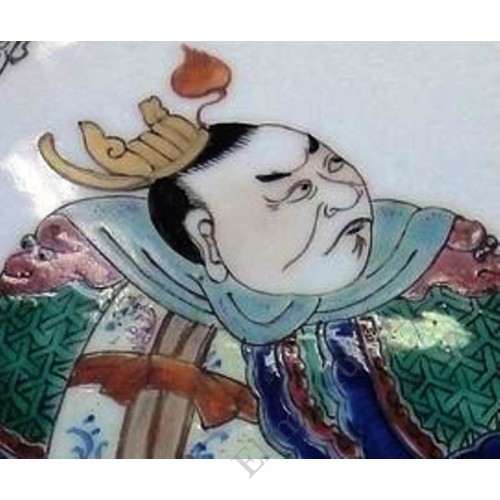
The identifiable figures include Xiang Ji, the Hegemon-King of Western Chu; Sun Ce, the Young Lord of Jiangdong; Dong Xian; and Su Ruolan, all of whom appear in the Wushuangpu. Each figure stands independently, with clothing, posture, and inscriptions conveying a distinct identity and temperament. Together, they form a group portrait spanning different historical eras.
The two military figures are particularly striking. Xiang Yu wears an elaborate helmet, with a thick beard and fierce eyes and brows. Clad in armor and holding a weapon, he projects an imposing presence. Sun Ce is likewise armored, but turns his head to gaze upward. The painter emphasizes the lines of his brow ridges, the corners of his eyes, and his cheeks, giving him a solemn, vigilant expression. Animal-mask shoulder ornaments, overlapping armor plates, and fluttering sashes enrich the decoration while reinforcing the figures’ sense of strength. By contrast, Dong Xian has delicate features and wears a flower-patterned robe. Holding a ceremonial tablet in both hands, he stands with dignified composure, in marked contrast to the warriors’ vigor. The female figure of Su Ruolan adds a further dimension of literary talent and emotion to the ensemble.
Pale green, pink, light blue, purple, and yellow enamels are combined throughout the decoration. Small floral patterns on the robes, geometric designs on the armor, and hair and beards delineated in black create rich, finely differentiated layers of detail. The painter slightly exaggerates the facial contours, giving each figure distinctive eyes, brows, nose, and expression. Generous areas of white ground surround the figures, making their elaborate clothing and vivid expressions all the more prominent. A fine line of gilding around the mouth adds a touch of luxury to the vase’s overall elegance.
By the time the Wushuangpu became popular in porcelain decoration during the Daoguang reign, nearly two centuries had passed since its publication in the Kangxi period. Why did an old album of historical figures attract renewed interest at this particular moment? The Opium War, which broke out in 1840, may offer a clue to understanding the subsequent popularity of this subject. How was an ancient civilization, sustained for thousands of years, to respond to Western powers equipped with formidable warships and artillery? We may discern in these images a particular state of mind: a yearning for the heroes who had once commanded the course of events, imagining that they might somehow miraculously return to life, repel foreign enemies, and safeguard the nation’s fortunes. The profound anxiety expressed through such nostalgic contemplation of the past is not difficult to understand. It may reflect an instinctive response among Chinese people of the time to conflict and adversity—a search for strength in history.
Viewed from this perspective, the splendid figures on the vase embody not only later generations’ memories and imaginings of Chinese history, but perhaps also their spiritual longings in the face of present difficulties. As viewers turn the vessel and study the figures’ expressions, their immediate sense of defeat seems to find a measure of consolation. Recalling the great achievements and legendary lives of their forebears, they may feel as though they are drawing from them some mysterious source of courage and strength.