


Item No.: 1727
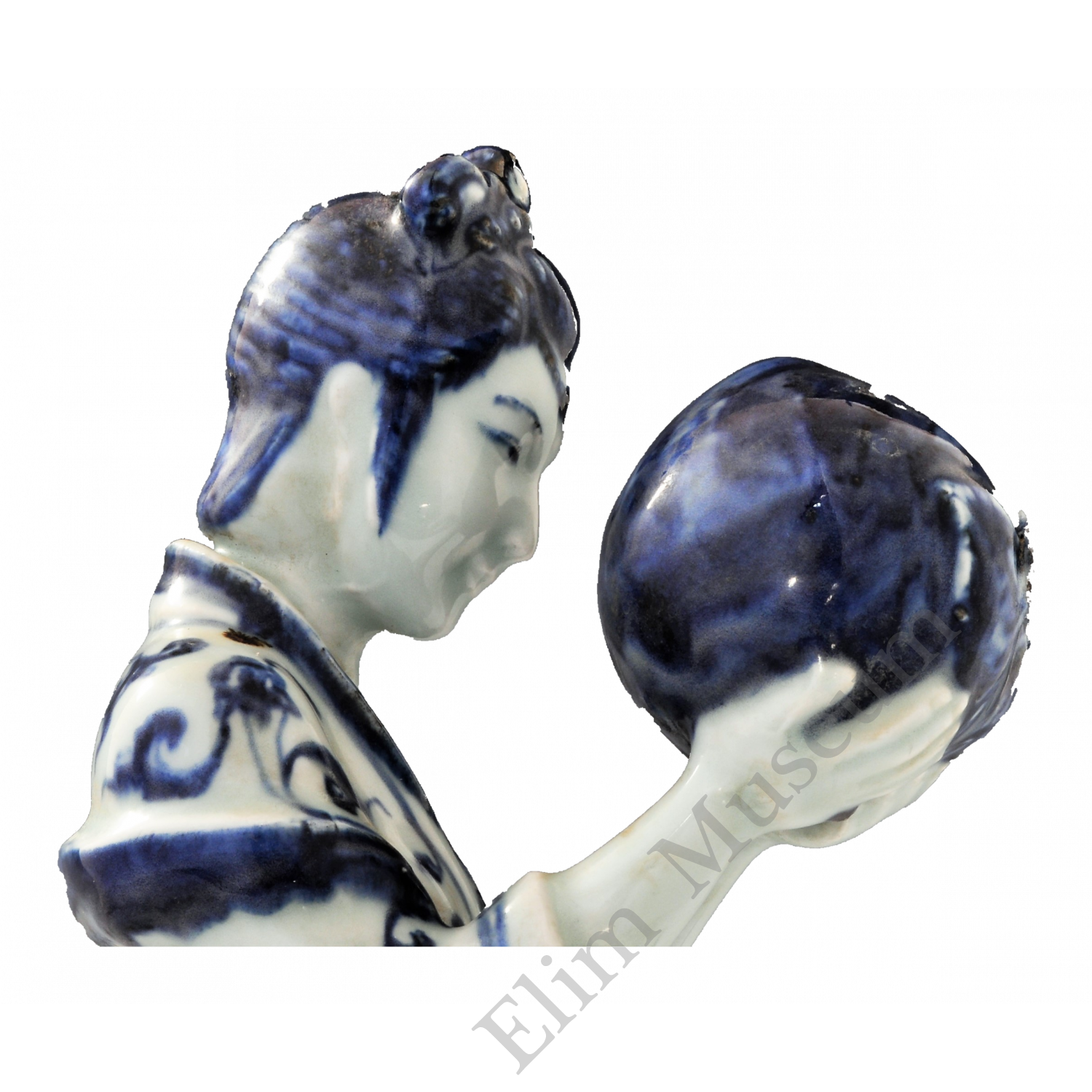
Name: Early Ming Blue-and-White Figure of Magu Presenting the Peaches of Longevity
Period: Early Ming dynasty
Height: 36.8 cm
This blue-and-white porcelain sculpture presents Magu offering a peach of longevity in the guise of a court lady. She wears a cross-collared robe drawn in at the waist, with wide sleeves hanging below her elbows. The outward-spreading folds at her shoulders contrast with her slender waist, while her long skirt falls to her feet, its hem trailing slightly behind. A dark blue, ribbon-like ornament extends diagonally from her waist toward the back and down the skirt, lending a sense of movement to the still figure. Floral motifs and winding stems interlace across her garments, their varying shades of cobalt blue setting off the whiteness of her face and hands. Judging from the “Sumali blue” cobalt pigment used in the sculpture, the work is unlikely to date later than the mid-Ming period.
The court lady is tall and slender, standing gracefully with her hair gathered into a high coiffure of clearly defined, coiled locks. Her back is straight, her upper body leans slightly backward, and her chin is lowered. Her expression conveys humility and reverence, suggesting that she has received thorough training in court etiquette. With both arms raised, she supports the large peach from below and on either side, holding it level with her eyebrows. This gesture of lowering the gaze while raising the offering also recalls the ancient Chinese idiom “raising the tray to eyebrow level”: a wife lifts a tray of food to her eyebrows as an expression of respect for her husband. Here, a similar posture becomes a gesture of offering birthday blessings, bringing wishes for longevity and reverence together in a solemn act of presentation.
In the fourth century CE, as Christianity was spreading throughout the Roman Empire, the story of Magu first appeared in the Shenxian zhuan, traditionally attributed to Ge Hong. Although youthful in appearance, she claimed to have witnessed the Eastern Sea turn into mulberry fields three times. The striking contrast between her youthful appearance and her immense longevity made her a symbol of transcendence over time and immortality. Her account also provided the famous narrative behind the later idiom “the sea becomes mulberry fields,” which evokes the vast transformations of the world.
The legend of Magu’s transformation from a kind and charitable woman into a goddess of longevity spread through texts, paintings, and opera, making “Magu Offering Birthday Blessings” a familiar celebratory theme. Her image embodies the ancients’ simple longing for health and enduring youth, while offering consolation in the face of the human suffering brought by illness, aging, and death.