


Item No.: 1725
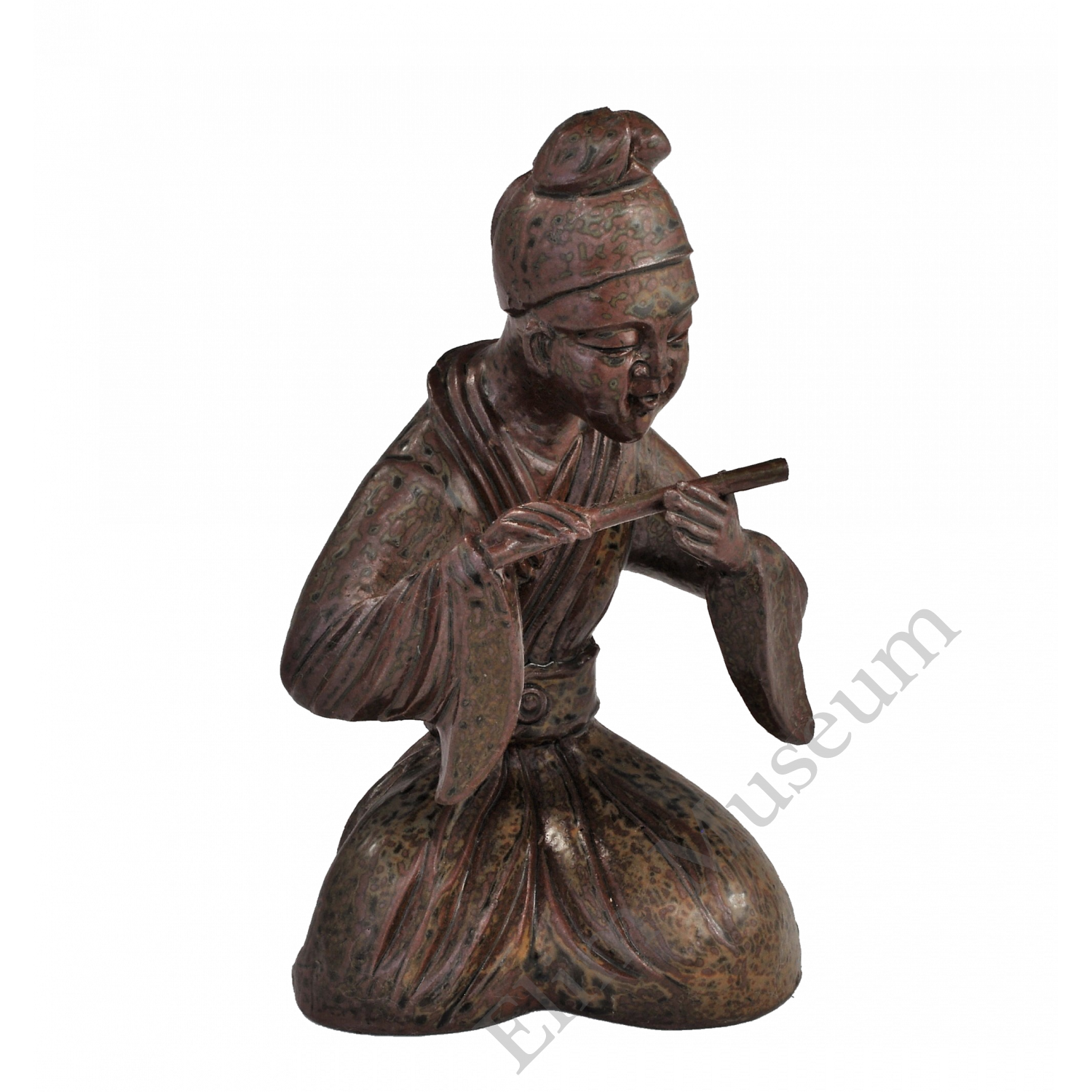
Name: Green-glazed porcelain sculpture: The Boy Playing the Flute
Period: 2nd–3rd century CE (tentative)
Height: 22.3 cm
This green-glazed porcelain sculpture portrays a young musician poised to begin playing, rendered with a striking sense of realism. The museum tentatively dates the work to the second or third century CE, spanning the Eastern Han and Three Kingdoms periods. The glaze’s soft lustre complements the finely modelled figure, conveying the distinctive appeal of early porcelain sculpture.
The youth has a delicate face, rounded cheeks and a firm chin, with an air of youthful innocence and reserve. Deep-set eyes, a high, straight nose and clearly defined lips give his features a strong sense of volume. His eyelids are gently lowered, the outer corners of his eyes subtly raised, and his lips slightly parted and upturned, as though he were holding his breath in anticipation of the first notes. A quiet excitement and pleasure emerge in his expression.
He kneels with his knees together, resting on his heels with his back upright. His hair is gathered at the crown, and he wears a loose robe crossed to the right, secured by a broad belt, with sleeves that fall naturally from his arms. His upper body inclines slightly to one side as he raises the flute horizontally to his lips. Flowing folds follow the movement of his torso and arms, lending a gentle, lively rhythm to his formal posture.
The sculpture presents a secular young musician in Han-style dress. His balanced proportions, deep-set eyes, straight nose and clearly articulated facial structure show a marked stylistic affinity with the realism of Gandharan art. This precise, three-dimensional modelling, together with his natural expression, allows the viewer to encounter a vivid human presence across the centuries. The concentration, anticipation and joy inspired by music give the exhibition’s theme of harmony an intimate human expression.