

Item No.: 1267
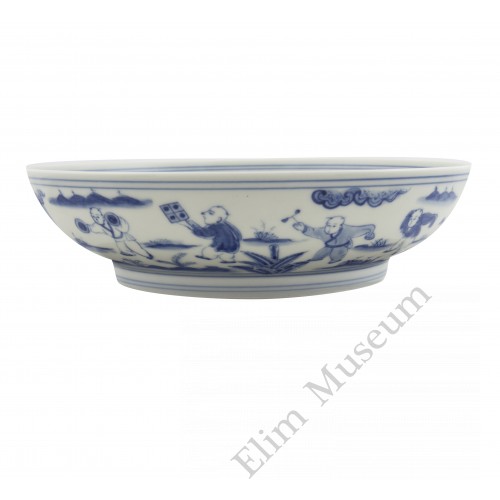
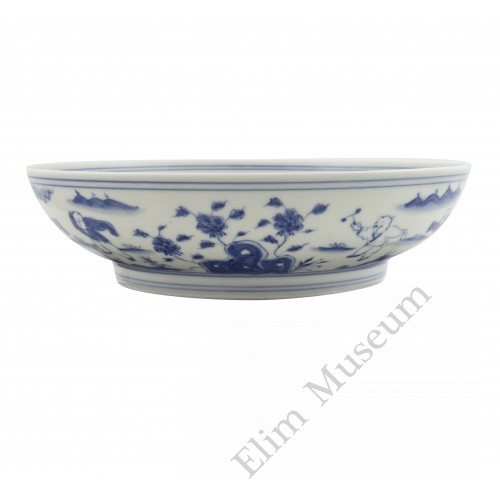
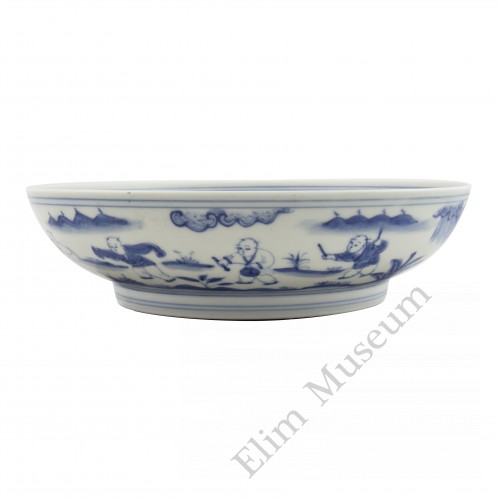
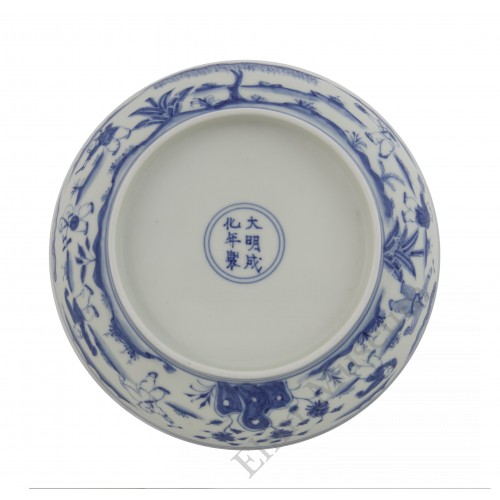
Name: Blue-and-White Dish with Palace Scenes and Children at Play
Period: Ming dynasty, Chenghua reign
Rim diameter: 18.5 cm
With its delicate blue tones, this blue-and-white dish creates a striking contrast between two scenes on its interior and exterior. At the center, pavilions, balustrades, upturned eaves, pine trees, plantain leaves, and hanging palace curtains form a quiet yet splendid palace garden. A child in dark robes sits alone before the steps, his lips pouting and his eyes wide open, gazing forlornly toward the lower right. Another child of a similar age passes beside him with cold indifference. Although the two are close at hand, their eyes do not visibly meet. They seem to know one another, yet convey a sense of being worlds apart despite their physical proximity.
In contrast, the children on the dish’s exterior hold various musical instruments, including nao and bo cymbals and drums, playing music and dancing with joyful abandon, as though celebrating the Lantern Festival. Through delicate blue tones with subtle variations in intensity, spacious areas left unpainted, and distinctive individual poses, the painter brings stillness and bustle, solitude and joy together on a single vessel. The exuberance outside the palace walls stands in sharp contrast to the coldness and loneliness within.
This is a blue-and-white work whose meaning is elusive and difficult to decipher. To grasp the artist’s intention precisely is undoubtedly challenging. Yet one painful episode in the life of the Chenghua Emperor, Zhu Jianshen, may offer a key to understanding it: at about five years of age, he was stripped of his position as crown prince by his uncle, the Jingtai Emperor, Zhu Qiyu, and replaced by his cousin Zhu Jianji, who was close to him in age. The child seated alone on the raised steps is himself as a boy; the slightly older child passing by below with indifference is his cousin, Zhu Jianji.
Although he later became emperor, this childhood experience, filled with fear and uncertainty, may already have left an indelible mark on his memory. Viewed from this perspective, the estrangement between the two children in the painting seems to echo the predicament of Zhu Jianshen and Zhu Jianji: related by blood, yet like strangers to one another. However lively and noisy the world outside might have been, he may have found it difficult to confide his inner loneliness and fear to anyone. If he participated in conceiving the painted design for this porcelain dish, might he, consciously or unconsciously, have left within the scene these childhood memories of loneliness and helplessness?