/DSC_0459-500x500-product_thumb.JPG "1377 Blue-and-White and Underglaze-Red Large Jar with Animal-Head Handles and Figures from the Water Margin")
/DSC_0461-500x500-product_thumb.JPG "1377 Blue-and-White and Underglaze-Red Large Jar with Animal-Head Handles and Figures from the Water Margin")
/DSC_0462-500x500-product_thumb.JPG "1377 Blue-and-White and Underglaze-Red Large Jar with Animal-Head Handles and Figures from the Water Margin")
/DSC_0464-500x500-product_thumb.JPG "1377 Blue-and-White and Underglaze-Red Large Jar with Animal-Head Handles and Figures from the Water Margin")
/DSC_0465-500x500-product_thumb.JPG "1377 Blue-and-White and Underglaze-Red Large Jar with Animal-Head Handles and Figures from the Water Margin")
Item No.: 1377
Name: Blue-and-White and Underglaze-Red Large Jar with Animal-Head Handles and Figures from the Water Margin
Period: Yuan dynasty
Height: 38.2 cm
From the Red Turban Army’s occupation of Jingdezhen in 1352, at the end of the Yuan dynasty, to Zhu Yuanzhang’s formal establishment of the Ming dynasty in 1368, Jingdezhen experienced an extraordinary period in its long history of porcelain production. The old regime was gradually collapsing, while a new dynasty had yet to be established. Against this exceptional historical backdrop, the kilns of Jingdezhen were no longer controlled by the “official authorities” in the traditional sense, but had fallen into the hands of these Han Chinese rebel forces, whose members wore red cloths around their heads.
This blue-and-white and underglaze-red large jar with animal-head handles and figures from the Water Margin may well be an extraordinary porcelain work produced in Jingdezhen during this period of social upheaval and political transition.
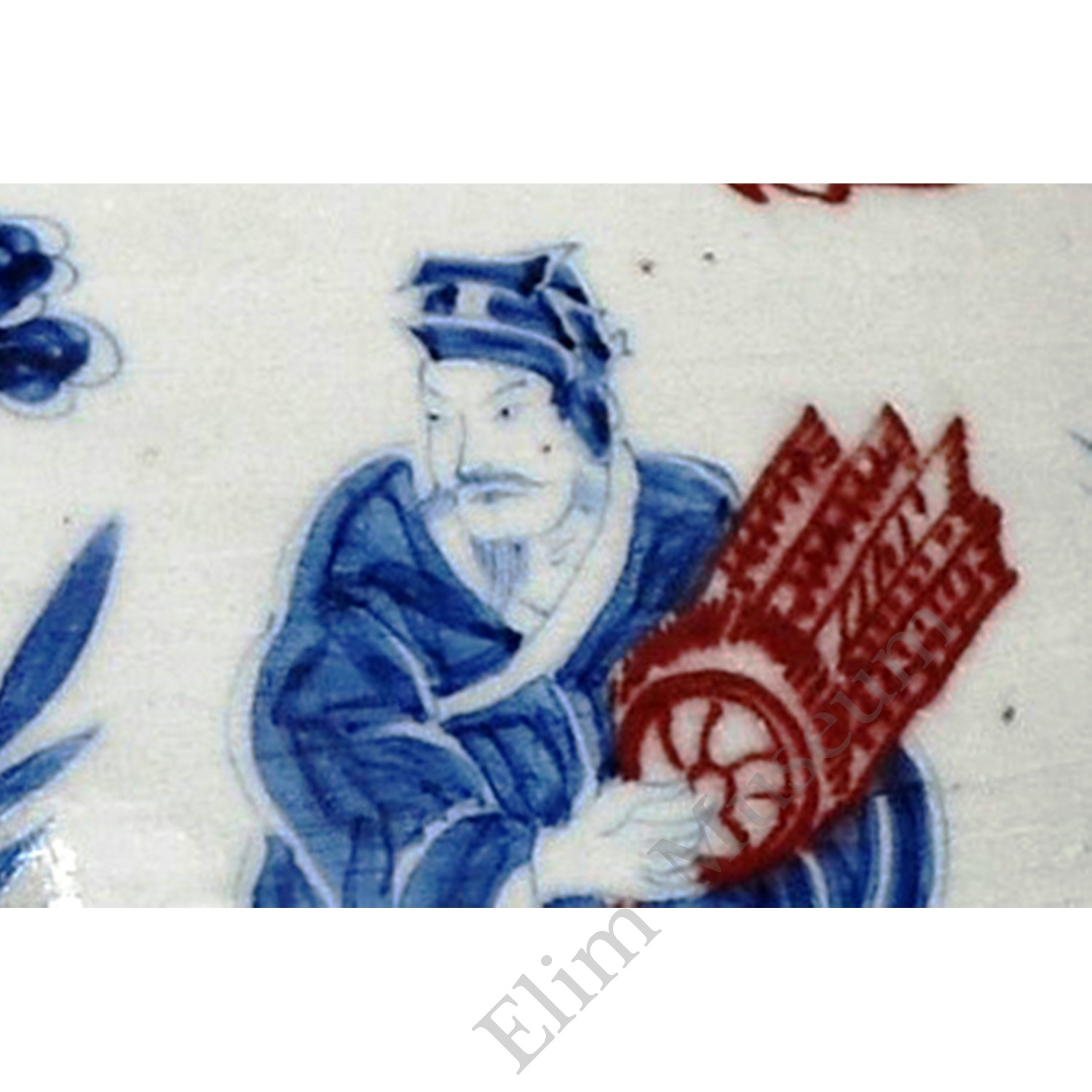
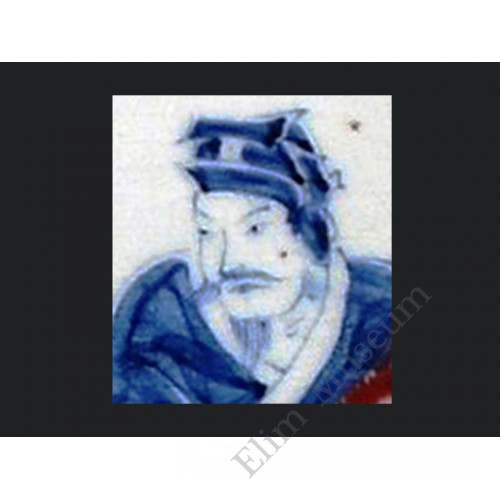
The principal figures depicted are evidently heroes from the Liangshan Marsh, as portrayed in the Water Margin, a story that was highly popular during the Song and Yuan periods. Among them are Wu Yong, holding a white feather fan; Song Jiang, the leader of Liangshan, carrying the three volumes of the celestial books bestowed upon him by the Dark Lady of the Ninth Heaven; and three other heroes brandishing large sabers, whose identities can no longer be determined with certainty.
What is thought-provoking, however, is that at the center of the composition, behind these heroes, the artist rendered in vivid red the command banner of Song Jiang, bearing the four characters “Act in the Name of Heaven.” In light of the historical context that the Red Turban Army controlled Jingdezhen for the decade from 1352 to 1363, this depiction naturally carries a particular meaning of its own. We suggest that the underlying metaphor is that the Red Turban Army sought to portray itself as righteous people, like the heroes of Liangshan, rising up against corrupt officials and brutal oppression, while likewise bearing a Heaven-given mission to rescue the suffering people of the world from misery and danger.
The dense red pigment in the composition also hints at this intention on the artist’s part. Historically, the Red Turban Army believed that it belonged to the element of fire within the Five Elements and therefore held red in especially high regard. They not only used red headcloths as their identifying emblem, but also frequently endowed red objects with special symbolic significance, such as red fish and red lotuses. Similarly, on this vessel, the artist appears to have made a deliberate arrangement: Wu Yong’s feather fan, the celestial books held by Song Jiang, the blooming red lotuses, the fences of the Liangshan stronghold, and, most notably, the command banner bearing the words “Act in the Name of Heaven” are all rendered in dense red pigment.
Finally, the overall workmanship of this vessel is also rather rough and plain. Its glaze layer is thin, its body clay is coarse, and its painting is relatively simplified. In terms of overall craftsmanship, it cannot be compared with the finely made Zhizheng-type blue-and-white porcelains. This suggests that its makers may have fallen far short of the more traditional porcelain kilns in terms of funding, manpower, experience, and other resources.
These shortcomings, however, do not diminish the vessel’s special significance in the history of Jingdezhen porcelain. It presents the Liangshan heroes—regarded by the ruling authorities as “rebels”—as positive figures, and emphasizes their ideals through the command banner proclaiming “Act in the Name of Heaven.” Such an explicit celebration of resistance is extremely rare in the history of ancient Chinese ceramics, both before and after this period.