


Item No.: 1053
Name: Kangxi Wucai Brush Pot with “The Dream at the Grass Bridge Inn”
Period: Qing dynasty, Kangxi reign
Height: 22.1 cm
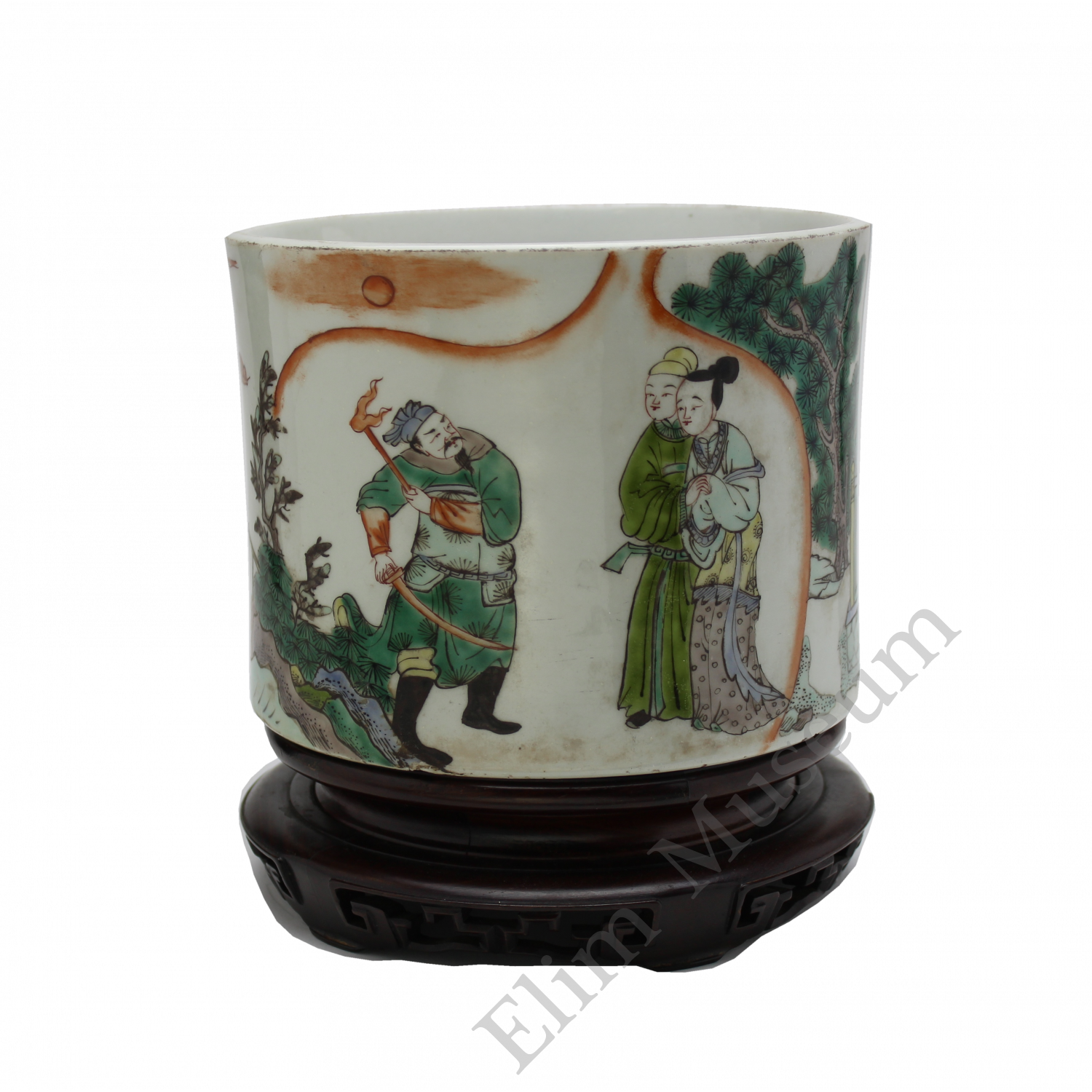
The ingenuity of this wucai brush pot, bearing the reign mark “Made during the Kangxi reign of the Great Qing,” lies in its simultaneous portrayal of a person's dream and waking reality. In a continuous composition encircling the vessel, the painter connects solitary sleep by candlelight, a reunion in a dream, and the approach of an armed intruder. An everyday scholar's object thus becomes a narrative space filled with longing, fear, and human conflict.
On one side, a scholar in a green robe sits at a desk, his cheek resting on one hand and his eyes gently closed in sleep. An open book, brushes, and an inkstone lie before him, while a candle continues to burn. The screen and window frames behind him, together with the railing in front of the desk, enclose a quiet interior. Rather than showing the turmoil of his awakening, the painter preserves his sleeping posture, allowing viewers first to encounter his solitude and then, as they turn the vessel, to enter the story unfolding in his mind.
On the other side, a winding, reddish-brown contour resembling cloud vapour separates the dream from the surrounding trees and rocks. Within it, the scholar and a young woman stand close together. Her hands are gathered at her chest, and he stands immediately behind her; their intimate poses suggest a recent reunion and a reluctance to part. Yet a bearded intruder wearing a headcloth has already approached them. Holding a torch in one hand and a curved blade in the other, he stands with his legs apart and turns to stare at the couple. The scene is suspended at the moment before tenderness is interrupted by violence. Their closely joined figures contrast sharply with the threatening blade and flame, making the happiness of the dream seem especially fragile.
This sequence—a scholar falling asleep, a reunion with his beloved, and the approach of an armed figure—corresponds to the “Dream at the Grass Bridge Inn” episode in Act Four of Book Four of Wang Shifu's The Romance of the Western Chamber. In the play, Yingying's mother makes success in the imperial examinations a condition of marriage, obliging Zhang Sheng to leave Cui Yingying and travel to the capital. While staying at the Grass Bridge Inn, he dreams that she has slipped away from her household and come alone to join him on his journey. No sooner are they reunited than soldiers carrying torches pursue her and seize her, startling Zhang Sheng awake. The painter condenses this dramatic sequence into a few interconnected images, enabling viewers to feel the tension between reunion and separation without reading the play's lyrics.
What makes the work particularly moving is that, although the dream is imaginary, its fear is rooted in reality. By day, the demands of official success and marriage force Zhang Sheng to travel far from his beloved; by night, he experiences the terror of losing her again in a dream. Separation in waking life and abduction in sleep thus echo one another. Read in this way, the armed intruder is more than a character advancing the plot: he may also symbolize the external forces that obstruct sincere affection and govern individual lives. Through the dream, the painter gives visible form to anxieties that are difficult to express, turning a romance of a scholar and a beauty into a reflection on the constraints of family status, official ambition, and marriage.
Artistically, the orderly lines of the interior architecture play against the flowing contour of the dream, while the sleeper's stillness contrasts with the armed figure's menace. Green enamels spread across robes and pine foliage; red accents mark the candle flame, the torch, and the dream's outline; yellow, blue, and brown are interwoven throughout. The painting holds both the quiet of a scholar's room at night and the unease of an impending nightmare. Its composition transcends ordinary time and space to convey deeply recognizable human feelings. Its critical force lies in prompting viewers to consider how oppressive the forces separating the lovers in waking life must be, when even their reunion in a dream cannot remain secure.