
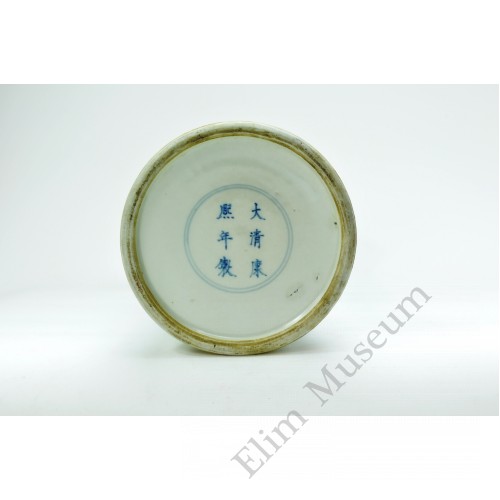
Item No.: 1195
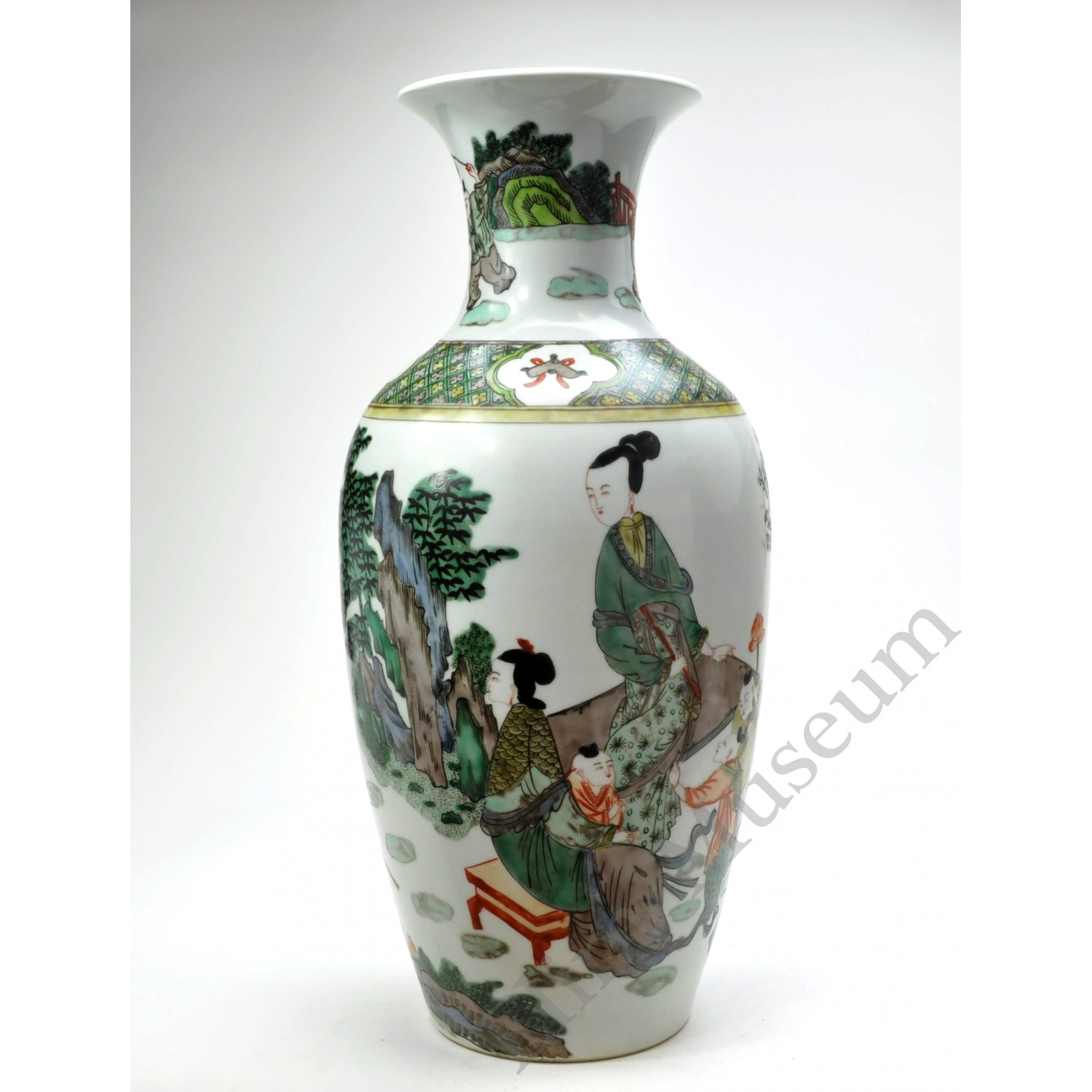
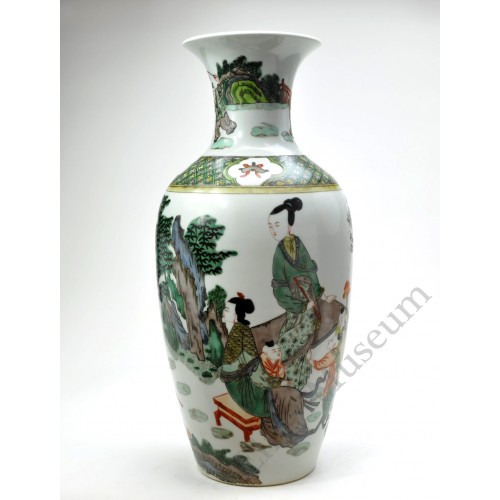
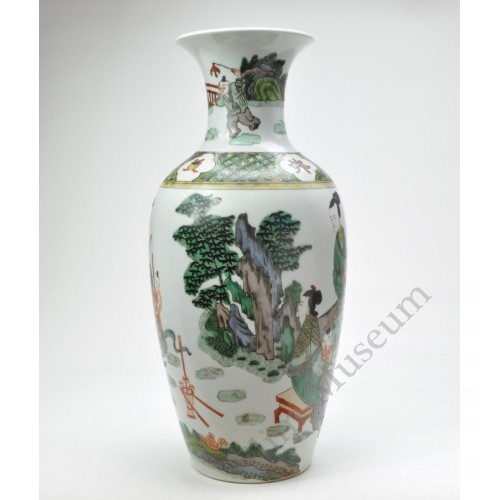
Name: A large wucai vase with figures playing touhu, the arrow-tossing game
Period: Qing dynasty, Kangxi reign
Height: 43.3 cm
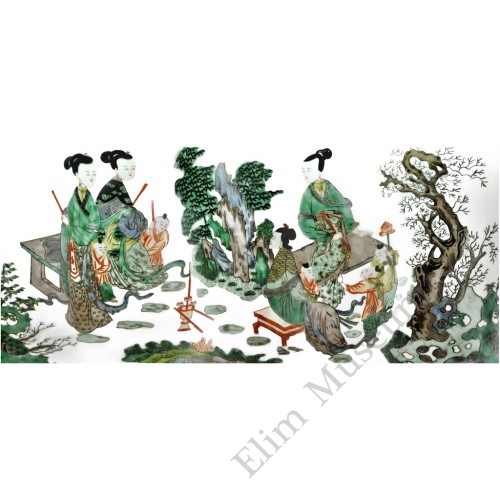
Interpreting this famille-verte vase depicting ladies in a garden is no easy task. Every figure and object in the scene seems to carry powerful symbolic and suggestive meanings. Such a carefully conceived composition is exceptionally rare in Chinese porcelain painting and may be regarded as a remarkably forward-looking work. Its subject may be connected with the strategy pursued by the Manchu rulers in the early Qing dynasty to win over the remnants of the former Ming imperial clan.
At the center of the scene, three noblewomen sit elevated above the others, occupying the position of hosts. Their expressions are difficult to read: some appear haughty, others compassionate, while their faint smiles seem to conceal their true thoughts. Below them, relegated to the position of guest, sits a woman in profile, visibly uneasy, with a timid young boy beside her. The woman wears a yellow sleeveless vest decorated with dragon-scale patterns, while the boy is dressed in traditional Han Chinese clothing with a Y-shaped overlapping collar. These details of dress seem to suggest that mother and son possess both Han Chinese ancestry and the status of descendants of the Ming imperial aristocracy.
By contrast, the collars worn by the three hostesses and the children beside them are mostly reversed, forming an inverted Y shape. This creates a striking contrast with the clothing of the visiting mother and son. If this difference is understood as a deliberate ethnic marker devised by the painter, the three hostesses may be identified as Manchu noblewomen. Looking down at the visiting woman with narrowed eyes, they seem to assume the posture of victors scrutinizing a consort of the former dynasty. Might the three noblewomen standing together also allude to the transfer of power across three generations—from Hong Taiji to the Shunzhi Emperor and then the Kangxi Emperor?
The game being played by the hosts and guests is touhu, or arrow pitching into a vessel, a pastime long popular among the traditional upper classes. Yet the visiting woman and child in the painting have nothing in their hands and no arrows left to throw; three arrows have already been cast, two of them missing their mark. Their opponents, by contrast, still hold arrows in hand, ready to take their turns. This stark imbalance in the contest may suggest that the Ming dynasty’s fortunes had been exhausted and its defeat had already become inevitable.
Part of the woman’s face is obscured by a garden rock, as though she has literally encountered a wall. This also evokes the predicament of having nowhere left to turn. At this moment, a boy with a slightly raised chin, narrowed eyes, and an air of youthful arrogance appears to be inviting the little “prince” beside her to join his side. Although the child still seems hesitant, his expression appears to reveal the first signs of temptation.
The painter has also cleverly placed a plump, richly dressed boy behind the inviter, holding a lotus flower aloft. In this narrative context, the Chinese word for “lotus,” lian, is homophonous with the word meaning “to connect” or “continuously,” and may be understood as an allusion to repeated advancement and rising success. If the descendants of the former dynasty were willing to change allegiance and become what might be called people who “recognize the times,” a path toward wealth, honor, and prosperity might open before them. Thus, what appears to be an ordinary game of touhu in a garden may in fact embody the difficult choice faced by the remnants of the Ming imperial clan during the dynastic transition—caught between dignity, belonging, and the lure of practical rewards.