
/DSC_0010-500x500-product_thumb.jpg "1413 A blue-and-white jar depicting the Three Visits to the Thatched Cottage")
/DSC_0024-500x500-product_thumb.jpg "1413 A blue-and-white jar depicting the Three Visits to the Thatched Cottage")
/DSC_0004-500x500-product_thumb.jpg "1413 A blue-and-white jar depicting the Three Visits to the Thatched Cottage")
/DSC_0022-500x500-product_thumb.jpg "1413 A blue-and-white jar depicting the Three Visits to the Thatched Cottage")
/DSC_0008-500x500-product_thumb.jpg "1413 A blue-and-white jar depicting the Three Visits to the Thatched Cottage")
Item No.: 1413
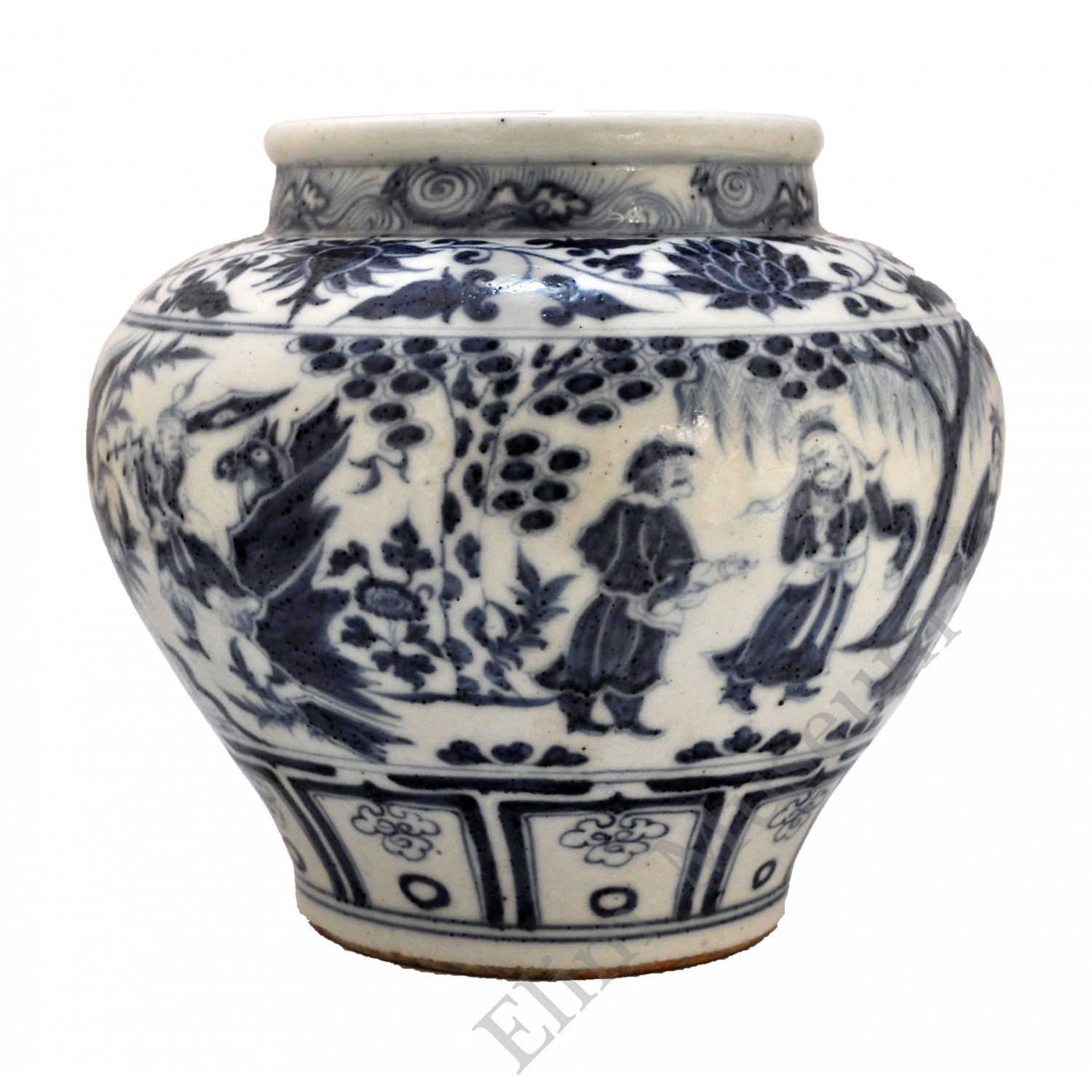
Name: A blue-and-white jar depicting the Three Visits to the Thatched Cottage
Period: Yuan dynasty
Height: 22.0 cm
At the end of the Eastern Han dynasty, rival warlords divided the realm. Determined to restore the Han imperial house and reunify the country, Liu Bei set aside the privileges of his rank to seek a worthy adviser. He visited Zhuge Liang three times at his secluded thatched cottage, asking him to leave his retreat and lend his assistance. Through later literary and theatrical retellings, these visits became the celebrated story of “Three Visits to the Thatched Cottage,” which provides the starting point for understanding this work.
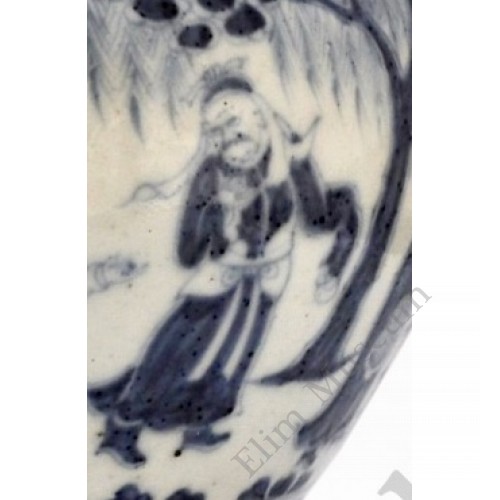
The stout, round-faced figure wearing a crown and a long robe, with a flowing beard, is likely Liu Bei. His head tilts slightly, both arms are raised, and his hands hang downward. His expression is respectful and earnest, as though he is about to bow, or even kneel in homage, vividly conveying his sincerity in humbling himself to seek a worthy adviser. An older man beside him extends a hand in a guiding gesture. He is likely Xu Shu, who recommended the master known as the “Crouching Dragon” to Liu Bei.
On the other side, Zhuge Liang sits beneath a tree, his posture composed and his expression serene. Two young attendants stand nearby: one appears to hold a book scroll or a qin, while the other faces his master, as though announcing a visitor at the gate. The burly man beneath the willow, possibly Zhang Fei, stands with his arms bent before his waist and his feet planted apart, conveying a rugged, forceful character. With economical lines and contrasting shades of cobalt blue, the painter recreates the story through a sequence of varied poses: guiding, bowing, announcing a visitor, and waiting while seated. These gestures also establish a striking contrast between the visitor’s eagerness and the recluse’s composure.
This work reflects one of the most difficult challenges shared by the various Han Chinese Red Turban forces, from whose ranks the founders of a new dynasty would emerge, as they competed to reunify the realm following the collapse of the central dynasty’s ruling order in the late Yuan period: whoever was most adept at promoting new talent and drawing capable people into his service would be most likely to become the ruler who united the Central Plains. This is the work’s most significant underlying message.