/DSC_0345-500x500-product_thumb.jpg "1384 Large Blue-and-White and Underglaze-Red Jar with Warriors on Horseback and Twin Beast-Head Handles")
/DSC_0353-500x500-product_thumb.jpg "1384 Large Blue-and-White and Underglaze-Red Jar with Warriors on Horseback and Twin Beast-Head Handles")
-500x500-product_thumb.jpg "1384 Large Blue-and-White and Underglaze-Red Jar with Warriors on Horseback and Twin Beast-Head Handles")
/DSC_0346-500x500-product_thumb.jpg "1384 Large Blue-and-White and Underglaze-Red Jar with Warriors on Horseback and Twin Beast-Head Handles")
/DSC_0348-500x500-product_thumb.jpg "1384 Large Blue-and-White and Underglaze-Red Jar with Warriors on Horseback and Twin Beast-Head Handles")
-500x500-product_thumb.jpg "1384 Large Blue-and-White and Underglaze-Red Jar with Warriors on Horseback and Twin Beast-Head Handles")
/DSC_0354-500x500-product_thumb.jpg "1384 Large Blue-and-White and Underglaze-Red Jar with Warriors on Horseback and Twin Beast-Head Handles")
Item No.: 1384
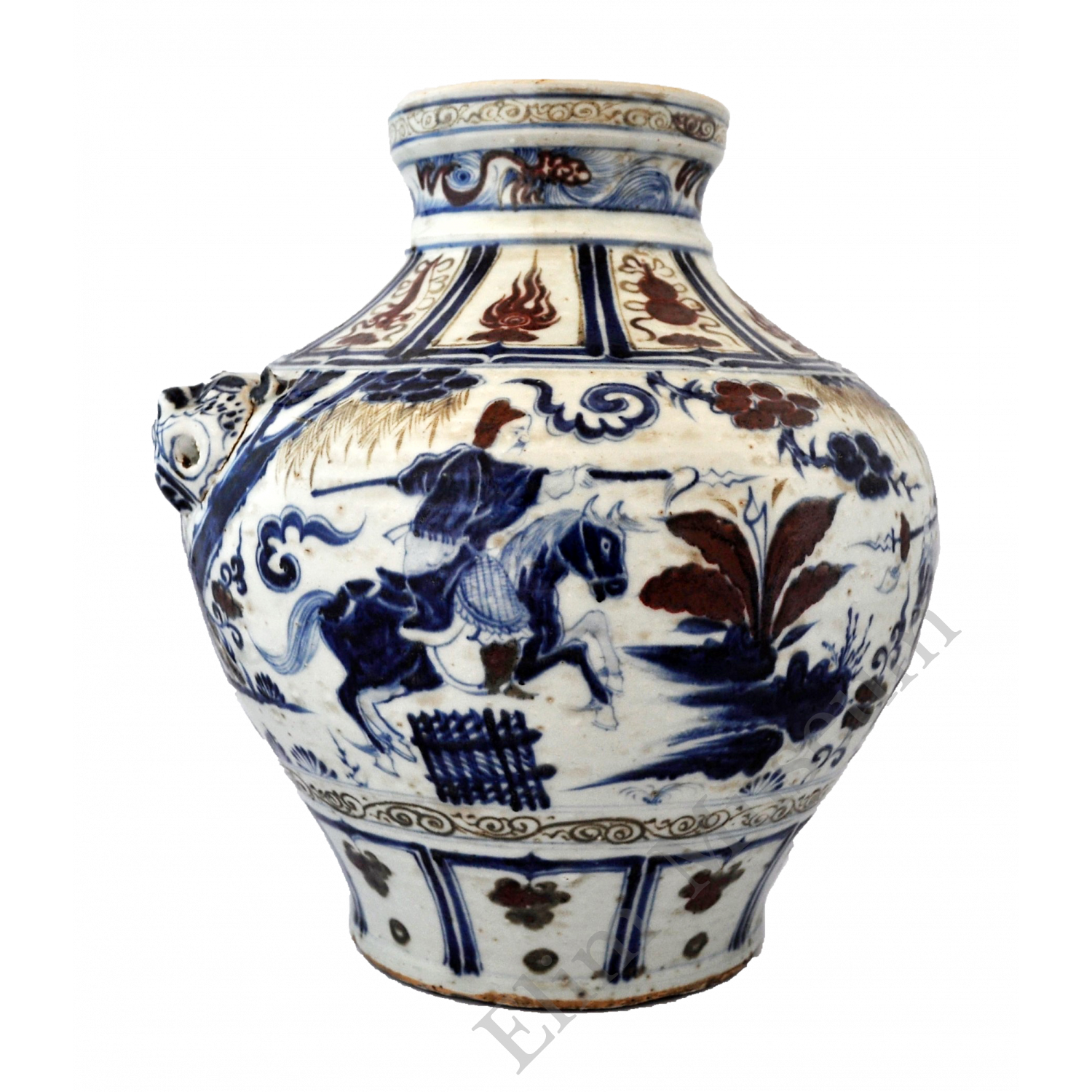
Name: Large Blue-and-White and Underglaze-Red Jar with Warriors on Horseback and Twin Beast-Head Handles
Period: Yuan dynasty
Rim diameter: 36.3 cm
During the decade from 1352 to 1362, Jingdezhen experienced an extraordinary period in its history of porcelain production. As the authority of the Yuan central government steadily weakened, Red Turban rebel forces took control of the surrounding region. Amid such profound historical upheaval, did Jingdezhen’s porcelain artisans leave behind artistic expressions that differed from those of earlier times? This large blue-and-white and underglaze-red jar with warriors on horseback and twin beast-head handles, in the collection of the Ailin Foundation, offers a clue worth exploring.
The figural scene on the jar can be understood as an encounter between Red Turban rebels and Mongol government troops on a battlefield in the late Yuan period. A man with a red cloth wrapped around his head holds a spear and urges his horse forward, apparently a warrior of the Red Turban army. Facing him is another warrior, wearing a felt hat and likewise charging on horseback with a spear. Judging from his attire and the arrangement of the figures, he most likely represents a Mongol general. The two riders advance toward each other, their spears crossing, condensing the violence of battle into a single heart-stopping instant.
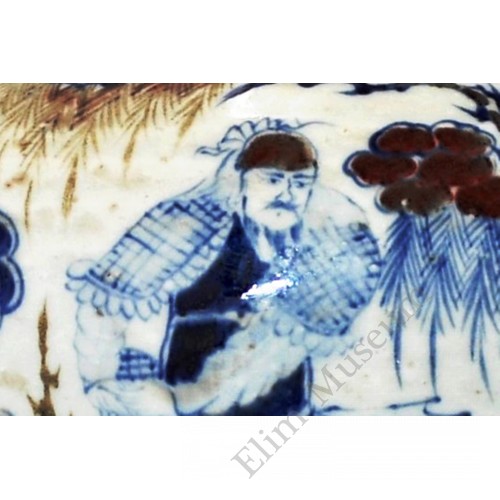
On the other side of the scene are two more figures wearing red headcloths. One holds a command banner and appears to be an attendant guard. The other sits on a large rock beside the banner; judging from his position and posture, he is very likely the commander of the Red Turban forces.
The seated figure appears deeply anxious. His weight shifts slightly to the right, his right foot braces against a smaller stone, and his hands overlap as they press upon his right knee. Although he makes no dramatic movement, this somewhat tense posture conveys his inner unease and apprehension, as though he were anxiously awaiting the outcome of a battle that remains deadlocked, with victory or defeat still uncertain.
In the composition, the artist has arranged two corresponding scenes, one dynamic and the other still. The first conveys the tension and intensity of the battlefield through the momentum of charging horsemen; the second directs attention toward a figure’s inner world, depicting the psychological strain of waiting through the inclination of his body, the placement of his hands, and his facial expression. A moment of mortal combat on one side mirrors the anxiety of an undecided outcome on the other, bringing both the outward conflict of war and the figures’ inner emotions onto the surface of the vessel.
Whether depicting the combatants’ strenuous struggle or the seated figure’s absorbed concern, the artist works with vitality and sensitivity. All four figures have distinctive faces and vivid expressions, with a pronounced sense of realism. This suggests that the maker may well have drawn inspiration from people and experiences in everyday life, rather than merely following established patterns of figural painting.
From the choice of subject and the arrangement of scenes to the portrayal of individual features and emotions, this work reveals an inventive artistic conception. It also has a strong documentary quality: the artist seems to adopt an eyewitness’s perspective, using the brush to record the conflict, tension, and anxiety experienced by people living through a change of dynasties. Although the imagery alone cannot establish whether it draws upon a particular battle, its close engagement with lived reality gives the work an especially vivid sense of its time.
These artistic qualities give the jar a noteworthy value as an original creation. It not only brings the intensity of warfare into porcelain painting, but also allows viewers, through the expressions and postures of individual figures, to sense the concrete and deeply human experiences of those caught in a moment of profound historical change.