


Item No.: 1724
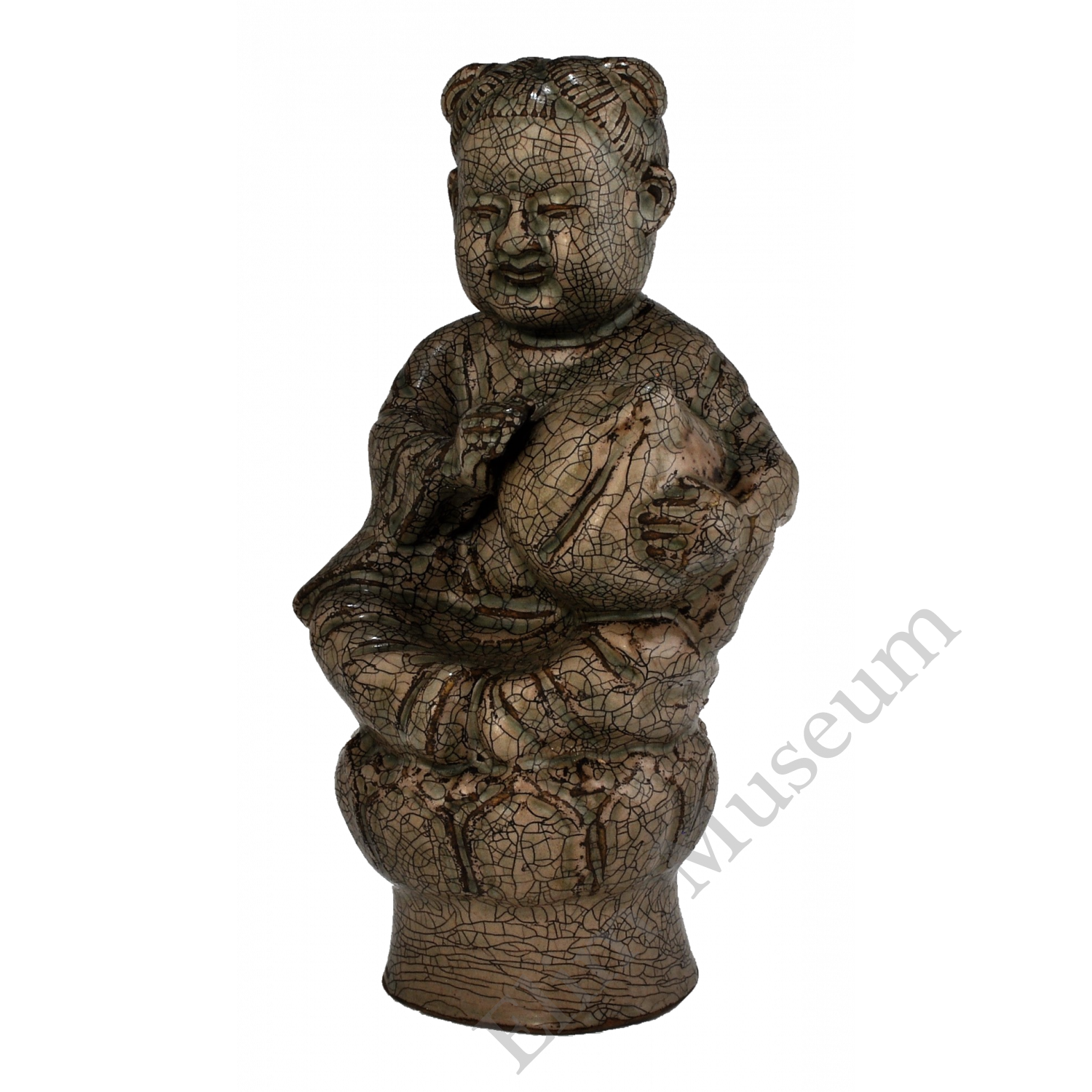
Name: Pre-Tang Yue ware figure of a boy holding a peach
Period: Pre-Tang
The boy’s hair is swept to either side and coiled into a pair of rounded buns. A short lock falls over his forehead, its ends divided into small, uneven tufts. Fine incised lines on the buns trace the direction of the combed strands. Together with his full forehead and plump cheeks, these details give the child a particularly vivid and endearing appearance.
Compared with the two preceding musician figures, whose modelling evokes Gandharan art, this child has softer, more rounded facial contours. Although his eyes are large, their sockets are shallow and smoothly rounded. The sides of his nose are low, and the transitions between nose and cheeks are gentle, without sharp angles. A hint of a smile plays at the corners of his mouth, conveying a quiet, unaffected warmth and a strong sense of everyday life in China.
The boy sits upright with his legs bent, holding a peach in both hands. His fingers curl naturally around the fruit, while the folds of his clothing follow the contours of his body, giving the figure a convincing sense of volume. Tales circulating in the third and fourth centuries CE, such as those of the Queen Mother of the West’s peaches of immortality and Dongfang Shuo’s theft of the peaches, linked the fruit with aspirations to long life and immortality. These associations gradually developed into the familiar Chinese theme of offering peaches as birthday blessings. Uniting childhood innocence with wishes for longevity, this work expresses the enduring human hope for life to continue.