


Item No.: 1672
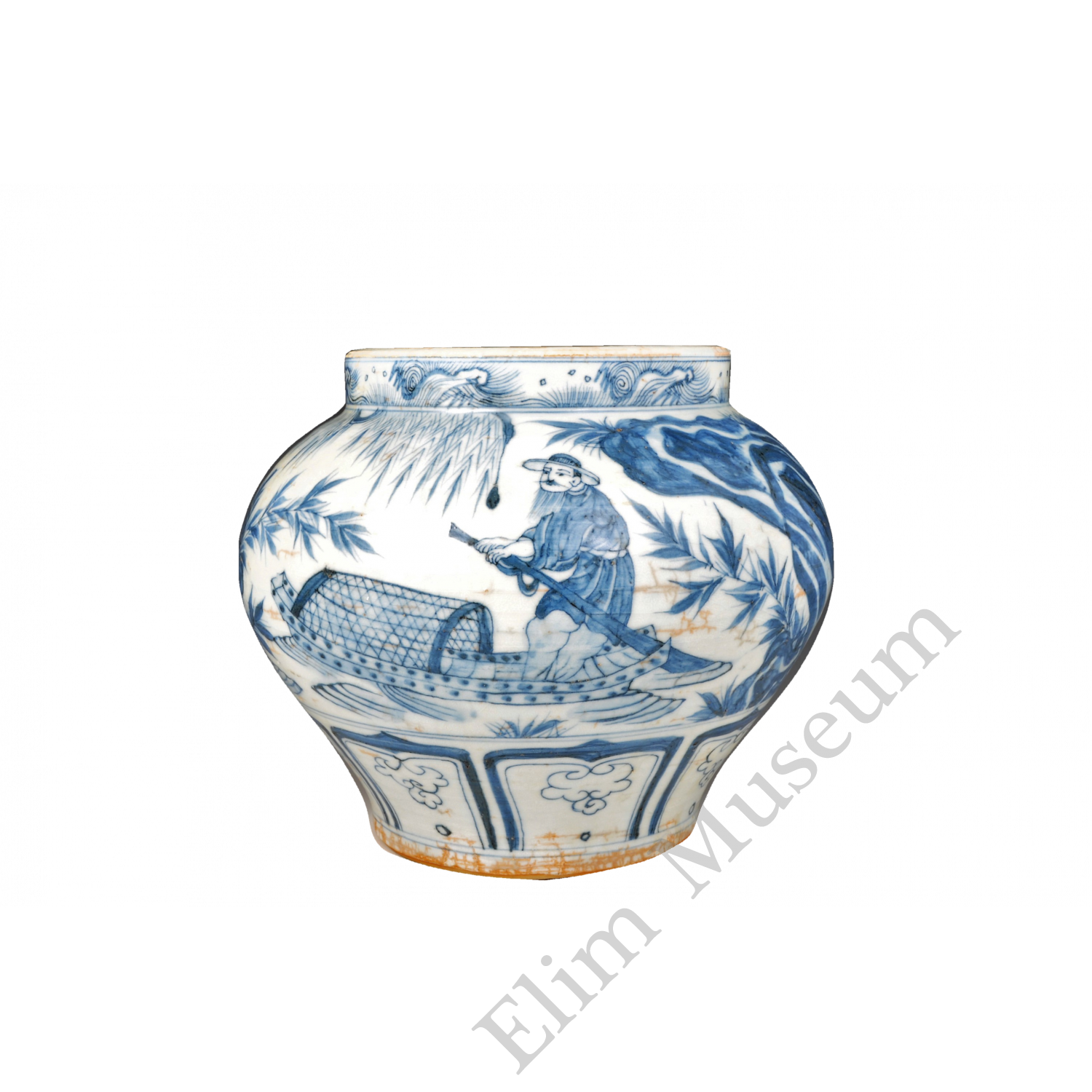
Name: A large blue-and-white jar with figures from The Peach Blossom Spring
Period: Yuan dynasty
Height: 19.8 cm
Tao Yuanming’s The Peach Blossom Spring tells the story of a fisherman from Wuling who follows a stream and unexpectedly enters a village secluded from the outside world. The villagers’ ancestors had brought their families there to escape warfare during the Qin dynasty. Generation after generation, their descendants cultivated the land and lived in peace. This simple, harmonious world, far removed from conflict, became the “Peach Blossom Spring” in which later generations invested their hopes for peace.
This large blue-and-white jar clearly takes its subject from Tao Yuanming’s story. The stone marker at the center of the composition, inscribed with the three characters 桃花源—“Peach Blossom Spring”—plainly identifies the theme.
The bearded figure wearing a bamboo hat, holding an oar with both hands, and standing in a small canopied boat is presumably the fisherman from Wuling who discovers this hidden sanctuary. Rippling water surrounds him, while vegetation and rocks line the banks, evoking his journey along the stream.
Elsewhere in the composition, an elderly man stands beside an ox, holding its tether in one hand and gently resting the other on its back. The ox lowers its head in a docile pose. The man’s appearance echoes the farmers in Tao Yuanming’s account, who “came and went, working the fields.” A nearby figure turns and extends a hand, seemingly engaged in conversation or pointing the way. Another figure, a woman, carries a tray with wine vessels and cups in both hands, as though preparing to welcome the visitor. This detail recalls the passage in which a villager “invited him home, served wine, and killed a chicken to prepare a meal.”
The interconnected scenes of boating, tending an ox, conversing, and offering wine suggest a coherent interpretation: although the fisherman has entered their world by chance, the villagers warmly welcome this unexpected stranger. They show neither hostility nor indifference, much less any inclination to mistreat him. Through these everyday gestures, the painter gives visual form to the literary ideal of a joyful, harmonious community in which neither the young nor the old are deceived or exploited.
In its craftsmanship and painting style, this work resembles collection no. 1377 in our museum. Both are relatively coarse in their overall execution, with a thin glaze, a coarse ceramic body, and the use of domestic cobalt pigment among their most prominent characteristics. Yet the faces, though rendered with few brushstrokes, reveal considerable mastery of baimiao, the art of expressive outline drawing. The lines are precise, lively, and evocative. With only a handful of strokes, the painter vividly captures each figure’s distinctive facial shape and expression—an accomplishment beyond the easy reach of an ordinary artisan.
If we further interpret the work against the backdrop of frequent warfare and social upheaval in the late Yuan period, this painted scene may be understood as an expression of the longing for harmony and peace. The kindness of its figures can be read as a silent response to the indifference, estrangement, persecution, and killing of the surrounding world. Through the story of the Peach Blossom Spring, the artist conveys both a personal reflection on suffering and a profound yearning for a settled life, secure livelihoods, and peaceful coexistence.