Conflict and Harmony — Part II
II. Figures in Painting
The works presented below are selected primarily from Yuan, Ming, and Qing dynasty porcelains painted with narrative figure scenes. We will focus on analyzing their artistic characteristics, interpreting their historical contexts, and reinterpreting the meanings hidden within the imagery.
From the Red Turban Army’s occupation of Jingdezhen in 1352, at the end of the Yuan dynasty, to Zhu Yuanzhang’s formal establishment of the Ming dynasty in 1368, Jingdezhen experienced an extraordinary period in its long history of porcelain production. The old regime was gradually collapsing, while a new dynasty had yet to be established. Against this exceptional historical backdrop, the kilns of Jingdezhen were no longer controlled by the “official authorities” in the traditional sense, but had fallen into the hands of these Han Chinese rebel forces, whose members wore red cloths around their heads.
This blue-and-white and underglaze-red large jar with animal-head handles and figures from the Water Margin may well be an extraordinary porcelain work produced in Jingdezhen during this period of social upheaval and political transition.
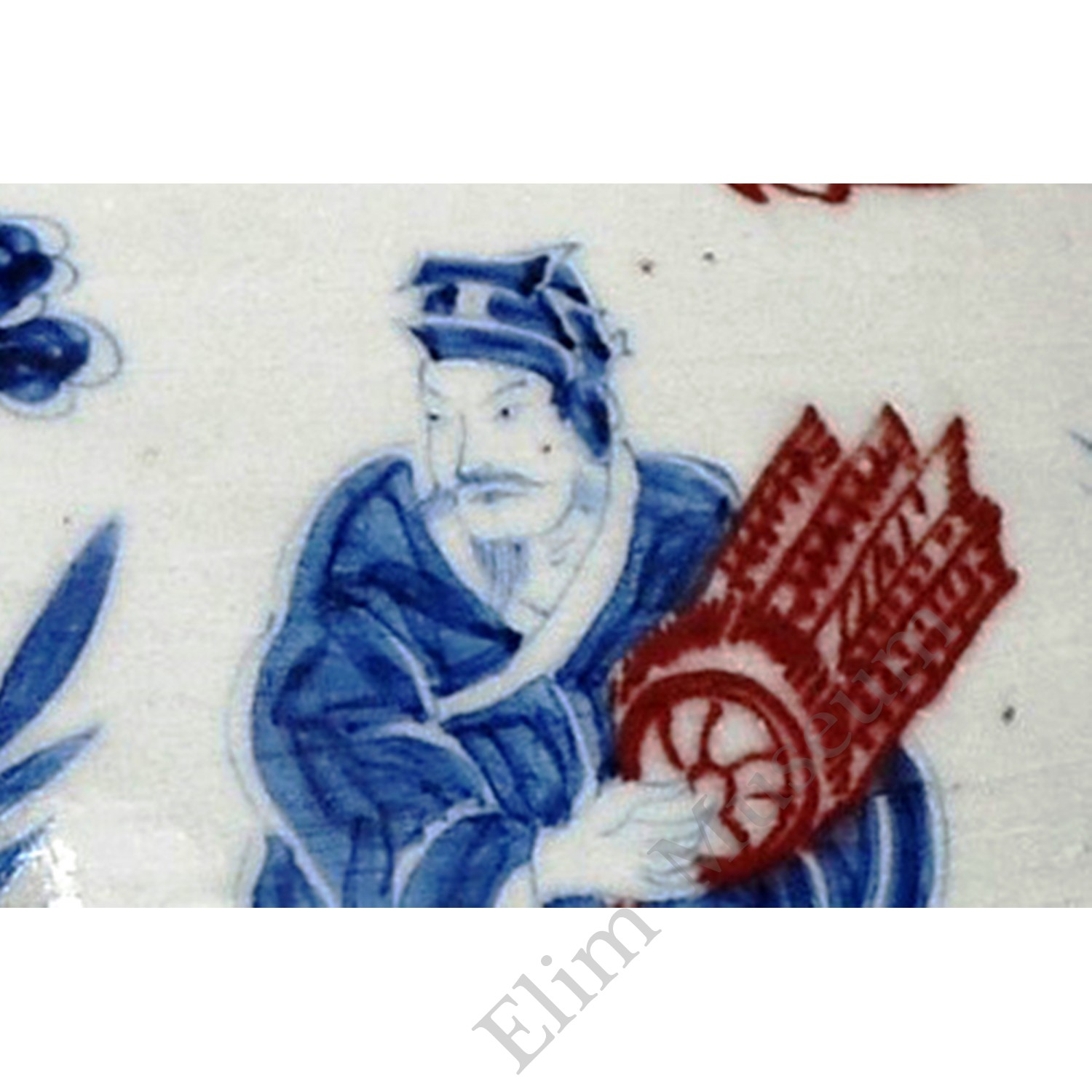
The principal figures depicted are evidently heroes from the Liangshan Marsh, as portrayed in the Water Margin, a story that was highly popular during the Song and Yuan periods. Among them are Wu Yong, holding a white feather fan; Song Jiang, the leader of Liangshan, carrying the three volumes of the celestial books bestowed upon him by the Dark Lady of the Ninth Heaven; and three other heroes brandishing large sabers, whose identities can no longer be determined with certainty.
What is thought-provoking, however, is that at the center of the composition, behind these heroes, the artist rendered in vivid red the command banner of Song Jiang, bearing the four characters “Act in the Name of Heaven.” In light of the historical context that the Red Turban Army controlled Jingdezhen for the decade from 1352 to 1363, this depiction naturally carries a particular meaning of its own. We suggest that the underlying metaphor is that the Red Turban Army sought to portray itself as righteous people, like the heroes of Liangshan, rising up against corrupt officials and brutal oppression, while likewise bearing a Heaven-given mission to rescue the suffering people of the world from misery and danger.
The dense red pigment in the composition also hints at this intention on the artist’s part. Historically, the Red Turban Army believed that it belonged to the element of fire within the Five Elements and therefore held red in especially high regard. They not only used red headcloths as their identifying emblem, but also frequently endowed red objects with special symbolic significance, such as red fish and red lotuses. Similarly, on this vessel, the artist appears to have made a deliberate arrangement: Wu Yong’s feather fan, the celestial books held by Song Jiang, the blooming red lotuses, the fences of the Liangshan stronghold, and, most notably, the command banner bearing the words “Act in the Name of Heaven” are all rendered in dense red pigment.
Finally, the overall workmanship of this vessel is also rather rough and plain. Its glaze layer is thin, its body clay is coarse, and its painting is relatively simplified. In terms of overall craftsmanship, it cannot be compared with the finely made Zhizheng-type blue-and-white porcelains. This suggests that its makers may have fallen far short of the more traditional porcelain kilns in terms of funding, manpower, experience, and other resources.
These shortcomings, however, do not diminish the vessel’s special significance in the history of Jingdezhen porcelain. It presents the Liangshan heroes—regarded by the ruling authorities as “rebels”—as positive figures, and emphasizes their ideals through the command banner proclaiming “Act in the Name of Heaven.” Such an explicit celebration of resistance is extremely rare in the history of ancient Chinese ceramics, both before and after this period.
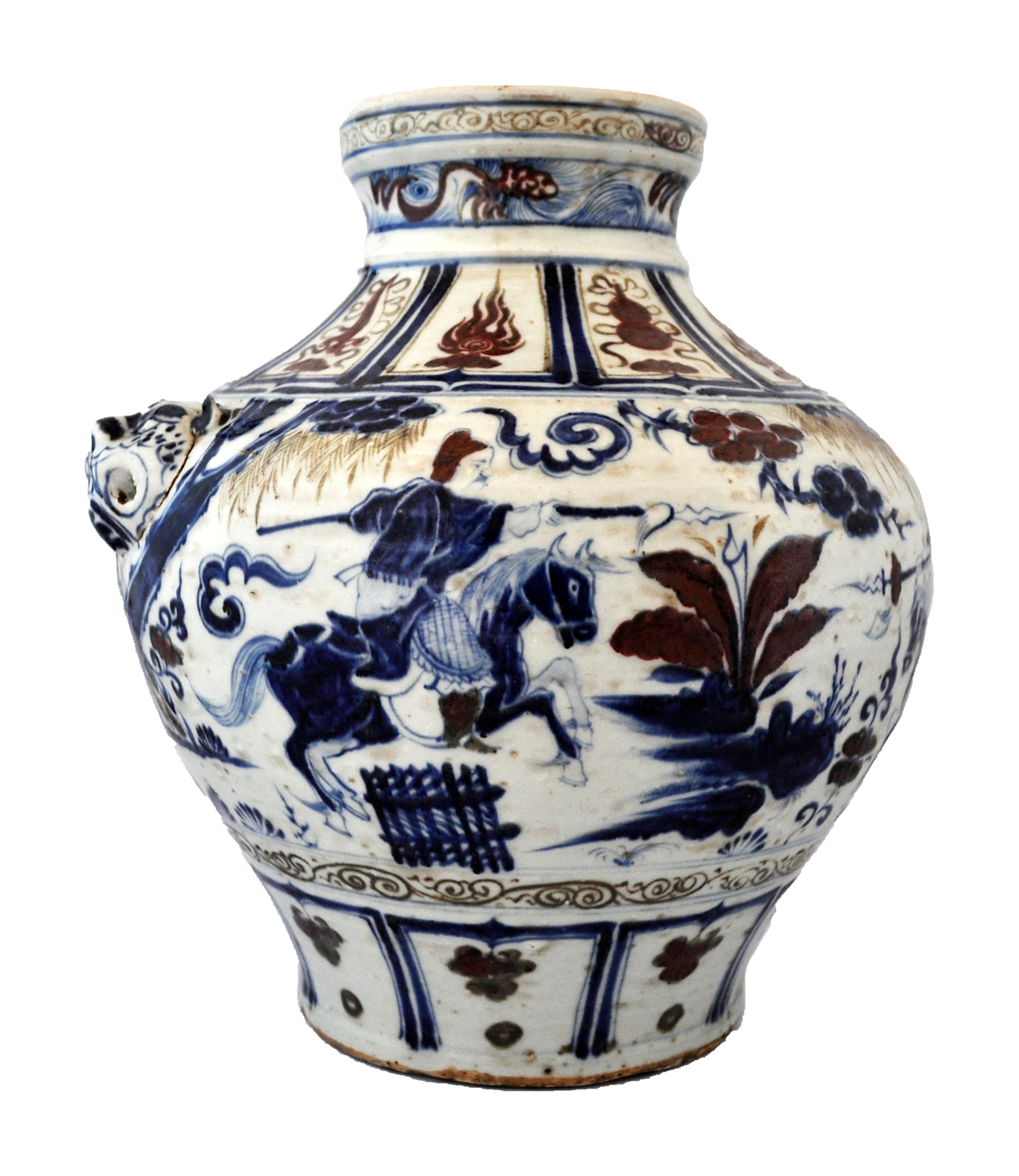
During the decade from 1352 to 1362, Jingdezhen experienced an extraordinary period in its history of porcelain production. As the authority of the Yuan central government steadily weakened, Red Turban rebel forces took control of the surrounding region. Amid such profound historical upheaval, did Jingdezhen’s porcelain artisans leave behind artistic expressions that differed from those of earlier times? This large blue-and-white and underglaze-red jar with warriors on horseback and twin beast-head handles, in the collection of the Ailin Foundation, offers a clue worth exploring.
The figural scene on the jar can be understood as an encounter between Red Turban rebels and Mongol government troops on a battlefield in the late Yuan period. A man with a red cloth wrapped around his head holds a spear and urges his horse forward, apparently a warrior of the Red Turban army. Facing him is another warrior, wearing a felt hat and likewise charging on horseback with a spear. Judging from his attire and the arrangement of the figures, he most likely represents a Mongol general. The two riders advance toward each other, their spears crossing, condensing the violence of battle into a single heart-stopping instant.
On the other side of the scene are two more figures wearing red headcloths. One holds a command banner and appears to be an attendant guard. The other sits on a large rock beside the banner; judging from his position and posture, he is very likely the commander of the Red Turban forces.
The seated figure appears deeply anxious. His weight shifts slightly to the right, his right foot braces against a smaller stone, and his hands overlap as they press upon his right knee. Although he makes no dramatic movement, this somewhat tense posture conveys his inner unease and apprehension, as though he were anxiously awaiting the outcome of a battle that remains deadlocked, with victory or defeat still uncertain.
In the composition, the artist has arranged two corresponding scenes, one dynamic and the other still. The first conveys the tension and intensity of the battlefield through the momentum of charging horsemen; the second directs attention toward a figure’s inner world, depicting the psychological strain of waiting through the inclination of his body, the placement of his hands, and his facial expression. A moment of mortal combat on one side mirrors the anxiety of an undecided outcome on the other, bringing both the outward conflict of war and the figures’ inner emotions onto the surface of the vessel.
Whether depicting the combatants’ strenuous struggle or the seated figure’s absorbed concern, the artist works with vitality and sensitivity. All four figures have distinctive faces and vivid expressions, with a pronounced sense of realism. This suggests that the maker may well have drawn inspiration from people and experiences in everyday life, rather than merely following established patterns of figural painting.
From the choice of subject and the arrangement of scenes to the portrayal of individual features and emotions, this work reveals an inventive artistic conception. It also has a strong documentary quality: the artist seems to adopt an eyewitness’s perspective, using the brush to record the conflict, tension, and anxiety experienced by people living through a change of dynasties. Although the imagery alone cannot establish whether it draws upon a particular battle, its close engagement with lived reality gives the work an especially vivid sense of its time.
These artistic qualities give the jar a noteworthy value as an original creation. It not only brings the intensity of warfare into porcelain painting, but also allows viewers, through the expressions and postures of individual figures, to sense the concrete and deeply human experiences of those caught in a moment of profound historical change.
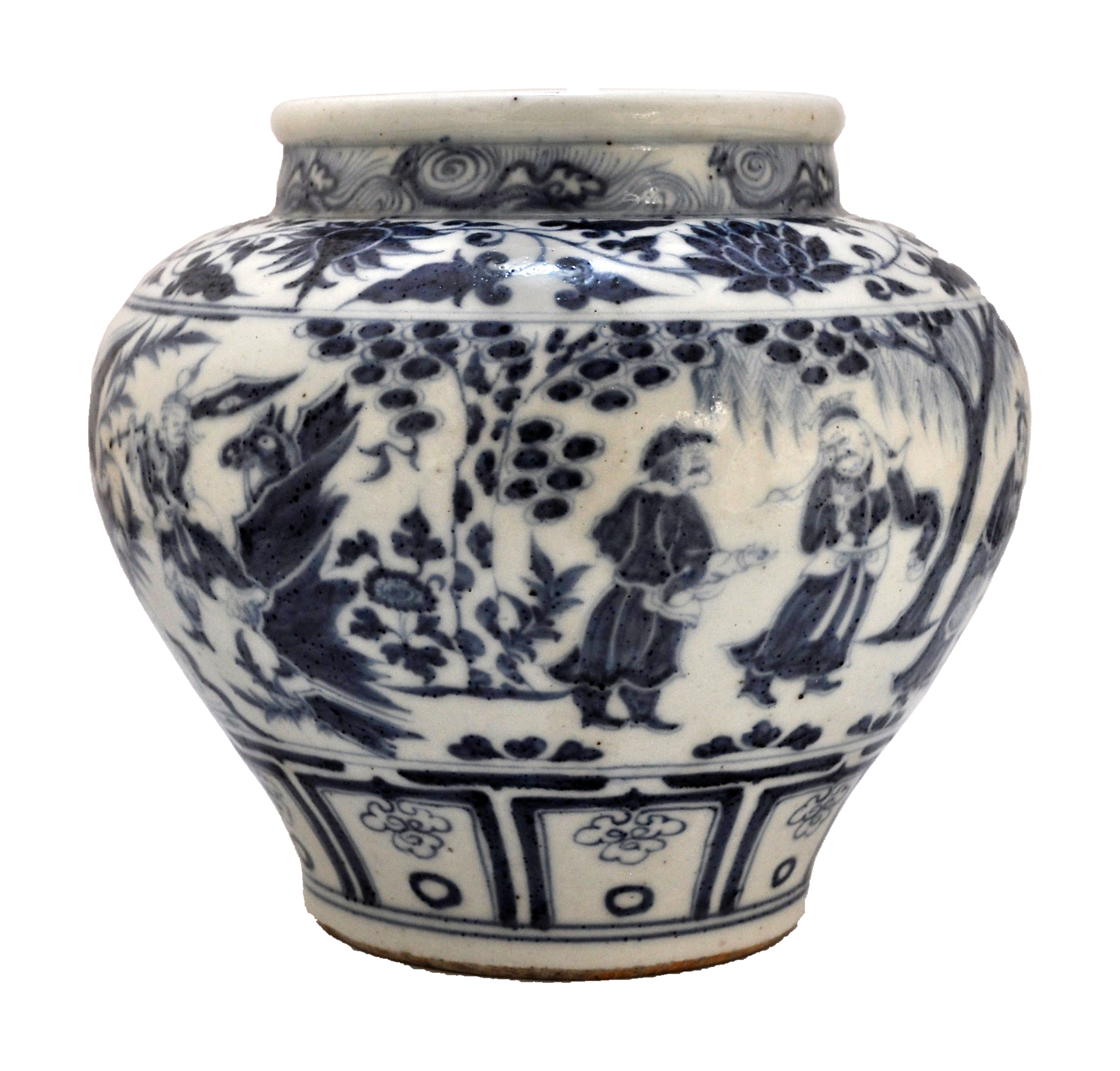
At the end of the Eastern Han dynasty, rival warlords divided the realm. Determined to restore the Han imperial house and reunify the country, Liu Bei set aside the privileges of his rank to seek a worthy adviser. He visited Zhuge Liang three times at his secluded thatched cottage, asking him to leave his retreat and lend his assistance. Through later literary and theatrical retellings, these visits became the celebrated story of “Three Visits to the Thatched Cottage,” which provides the starting point for understanding this work.
The stout, round-faced figure wearing a crown and a long robe, with a flowing beard, is likely Liu Bei. His head tilts slightly, both arms are raised, and his hands hang downward. His expression is respectful and earnest, as though he is about to bow, or even kneel in homage, vividly conveying his sincerity in humbling himself to seek a worthy adviser. An older man beside him extends a hand in a guiding gesture. He is likely Xu Shu, who recommended the master known as the “Crouching Dragon” to Liu Bei.
On the other side, Zhuge Liang sits beneath a tree, his posture composed and his expression serene. Two young attendants stand nearby: one appears to hold a book scroll or a qin, while the other faces his master, as though announcing a visitor at the gate. The burly man beneath the willow, possibly Zhang Fei, stands with his arms bent before his waist and his feet planted apart, conveying a rugged, forceful character. With economical lines and contrasting shades of cobalt blue, the painter recreates the story through a sequence of varied poses: guiding, bowing, announcing a visitor, and waiting while seated. These gestures also establish a striking contrast between the visitor’s eagerness and the recluse’s composure.
This work reflects one of the most difficult challenges shared by the various Han Chinese Red Turban forces, from whose ranks the founders of a new dynasty would emerge, as they competed to reunify the realm following the collapse of the central dynasty’s ruling order in the late Yuan period: whoever was most adept at promoting new talent and drawing capable people into his service would be most likely to become the ruler who united the Central Plains. This is the work’s most significant underlying message.
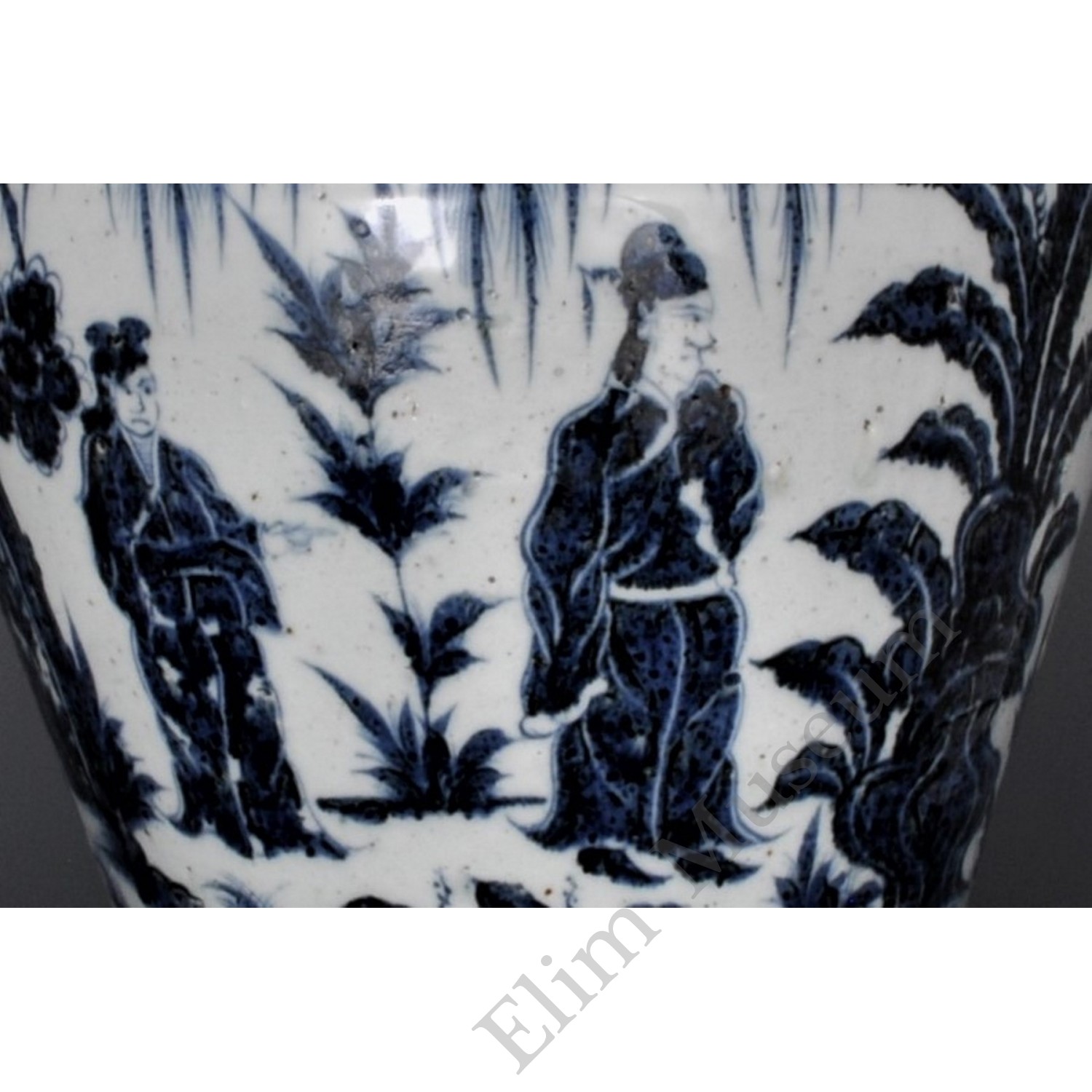
The Yuan-dynasty play Meng Yuemei Writes of Her Grief at the Brocade Fragrance Pavilion tells the story of the scholar Chen Gui and Meng Yuemei during the Tianbao era of Emperor Xuanzong of the Tang dynasty. They meet and fall in love, but the An Lushan Rebellion forces them apart. After many trials and hardships, the husband and wife are finally reunited. The Yuan blue-and-white porcelains depicting Jinxiangting that are currently seen on the market are all based on this plot. Their painters, however, conceived their compositions from the traditional perspective of “a talented scholar meeting a beautiful woman.” Most scenes therefore derive from the play’s opening episode: Chen Gui and Meng Yuemei meet by chance at the Brocade Fragrance Pavilion, fall in love at first sight, and privately pledge themselves to one another.
This Yuan blue-and-white meiping vase depicting Jinxiangting, however, departs from that conventional formula. Instead, it portrays the moving final episode of the drama: after more than ten years of painful separation and hardship, the two protagonists meet again at the Brocade Fragrance Pavilion, with the help of the celebrated general Guo Ziyi.
The man in the painting wears a tall headdress, a long robe, and a broad belt. His refined features and composed expression suggest a man in his prime who holds official rank. Behind him follows a young attendant, reverently holding in both hands a square object with four clearly defined corners. Its regular shape and the attendant’s respectful bearing suggest that it may well be an official seal or a box containing one. This is an important detail through which the painter hints at the figure’s identity, official position, and achievements in public service.
From these observations, we may infer that the man is Chen Gui, the story’s male protagonist. He is no longer the young scholar who first met Meng Yuemei, but a man who has achieved distinction, attained official rank, and returned home in honor.
The woman in the painting likewise seems no longer to be the young maiden who first encountered Chen Gui. Her face is full and rounded, her eyes and brows serene, her hair arranged in a high coiffure, and her clothing dignified. She conveys the presence of a mature woman, perhaps even one entering middle age. Her appearance and expression seem to bear traces of passing years and lived experience. Her image complements that of Chen Gui returning in triumph, bringing to mind a husband and wife who have endured the anguish of separation and the vicissitudes of life, only to be reunited at last.
Notably, the painter does not dramatize this long-awaited reunion through exaggerated gestures or intense displays of emotion. Instead, the figures’ restrained expressions and composed movements, together with the surrounding garden scenery, create a tranquil, poetic atmosphere. This understated yet richly narrative approach gives their inner feelings a deeper and more thought-provoking artistic power.
An intriguing question remains: what message was the artist seeking to convey through this episode? If we place the work against the historical background of the Red Turban uprisings in the late Yuan period, the weakening rule of the Mongol dynasty, and profound upheaval in the social order, we have reason to propose a deeper interpretation. This is far more than a conventional romantic tale of a talented scholar meeting a beautiful woman; it may be a work imbued with a profound sense of devotion to family and country. The painter’s deliberate choice of Chen Gui’s triumphant return and the couple’s reunion, rather than simply their first encounter and romantic pledge, clearly carries a deeper significance.
In traditional Chinese Confucian thought, learning is not merely a means of obtaining personal fame, wealth, or official rank. It also embraces the ideal of “cultivating oneself, bringing harmony to the family, governing the state, and bringing peace to all under Heaven.” Chen Gui’s story can be understood as an artistic expression of this ideal: through years of diligent study, he achieves distinction; through establishing himself, he assumes social responsibility; and finally, by returning home in honor and reuniting with his wife, he fulfills his commitments to family and life.
We may even speculate further: the artist may very well have intended to use Chen Gui’s story to encourage Han Chinese intellectuals to join the Han Chinese armed forces resisting Yuan rule, participate actively in social change, put their learning and talents to use, achieve distinction through service, and help rebuild the national order. In this sense, the Jinxiangting narrative on this Yuan blue-and-white porcelain may be a work whose outward subject is romantic devotion, while its deeper meaning concerns devotion to family and country. It offers a promising avenue for further exploration of the historical consciousness and humanistic spirit embodied in late Yuan porcelain painting.
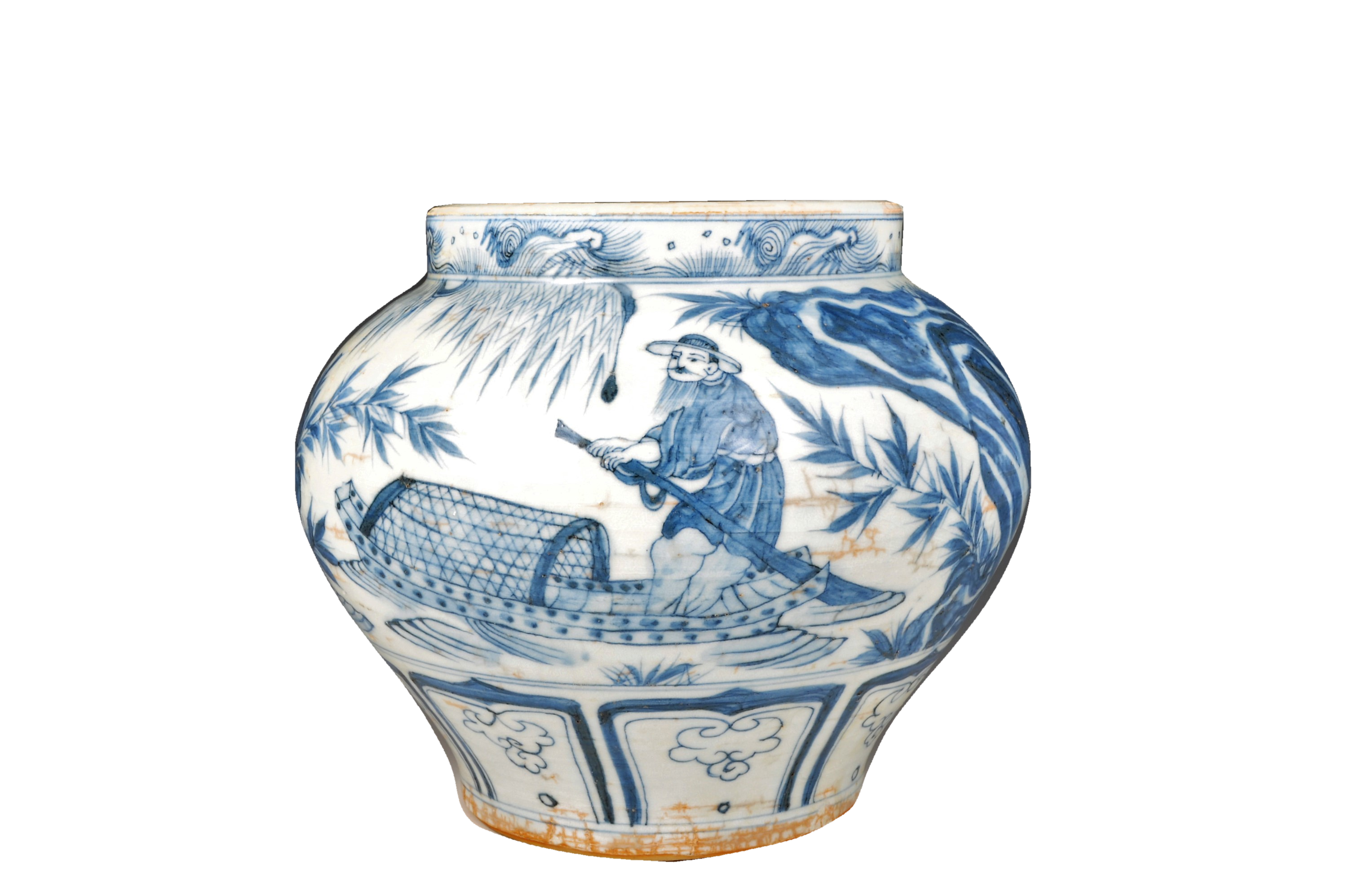
Tao Yuanming’s The Peach Blossom Spring tells the story of a fisherman from Wuling who follows a stream and unexpectedly enters a village secluded from the outside world. The villagers’ ancestors had brought their families there to escape warfare during the Qin dynasty. Generation after generation, their descendants cultivated the land and lived in peace. This simple, harmonious world, far removed from conflict, became the “Peach Blossom Spring” in which later generations invested their hopes for peace.
This large blue-and-white jar clearly takes its subject from Tao Yuanming’s story. The stone marker at the center of the composition, inscribed with the three characters 桃花源—“Peach Blossom Spring”—plainly identifies the theme.
The bearded figure wearing a bamboo hat, holding an oar with both hands, and standing in a small canopied boat is presumably the fisherman from Wuling who discovers this hidden sanctuary. Rippling water surrounds him, while vegetation and rocks line the banks, evoking his journey along the stream.
Elsewhere in the composition, an elderly man stands beside an ox, holding its tether in one hand and gently resting the other on its back. The ox lowers its head in a docile pose. The man’s appearance echoes the farmers in Tao Yuanming’s account, who “came and went, working the fields.” A nearby figure turns and extends a hand, seemingly engaged in conversation or pointing the way. Another figure, a woman, carries a tray with wine vessels and cups in both hands, as though preparing to welcome the visitor. This detail recalls the passage in which a villager “invited him home, served wine, and killed a chicken to prepare a meal.”
The interconnected scenes of boating, tending an ox, conversing, and offering wine suggest a coherent interpretation: although the fisherman has entered their world by chance, the villagers warmly welcome this unexpected stranger. They show neither hostility nor indifference, much less any inclination to mistreat him. Through these everyday gestures, the painter gives visual form to the literary ideal of a joyful, harmonious community in which neither the young nor the old are deceived or exploited.
In its craftsmanship and painting style, this work resembles collection no. 1377 in our museum. Both are relatively coarse in their overall execution, with a thin glaze, a coarse ceramic body, and the use of domestic cobalt pigment among their most prominent characteristics. Yet the faces, though rendered with few brushstrokes, reveal considerable mastery of baimiao, the art of expressive outline drawing. The lines are precise, lively, and evocative. With only a handful of strokes, the painter vividly captures each figure’s distinctive facial shape and expression—an accomplishment beyond the easy reach of an ordinary artisan.
If we further interpret the work against the backdrop of frequent warfare and social upheaval in the late Yuan period, this painted scene may be understood as an expression of the longing for harmony and peace. The kindness of its figures can be read as a silent response to the indifference, estrangement, persecution, and killing of the surrounding world. Through the story of the Peach Blossom Spring, the artist conveys both a personal reflection on suffering and a profound yearning for a settled life, secure livelihoods, and peaceful coexistence.
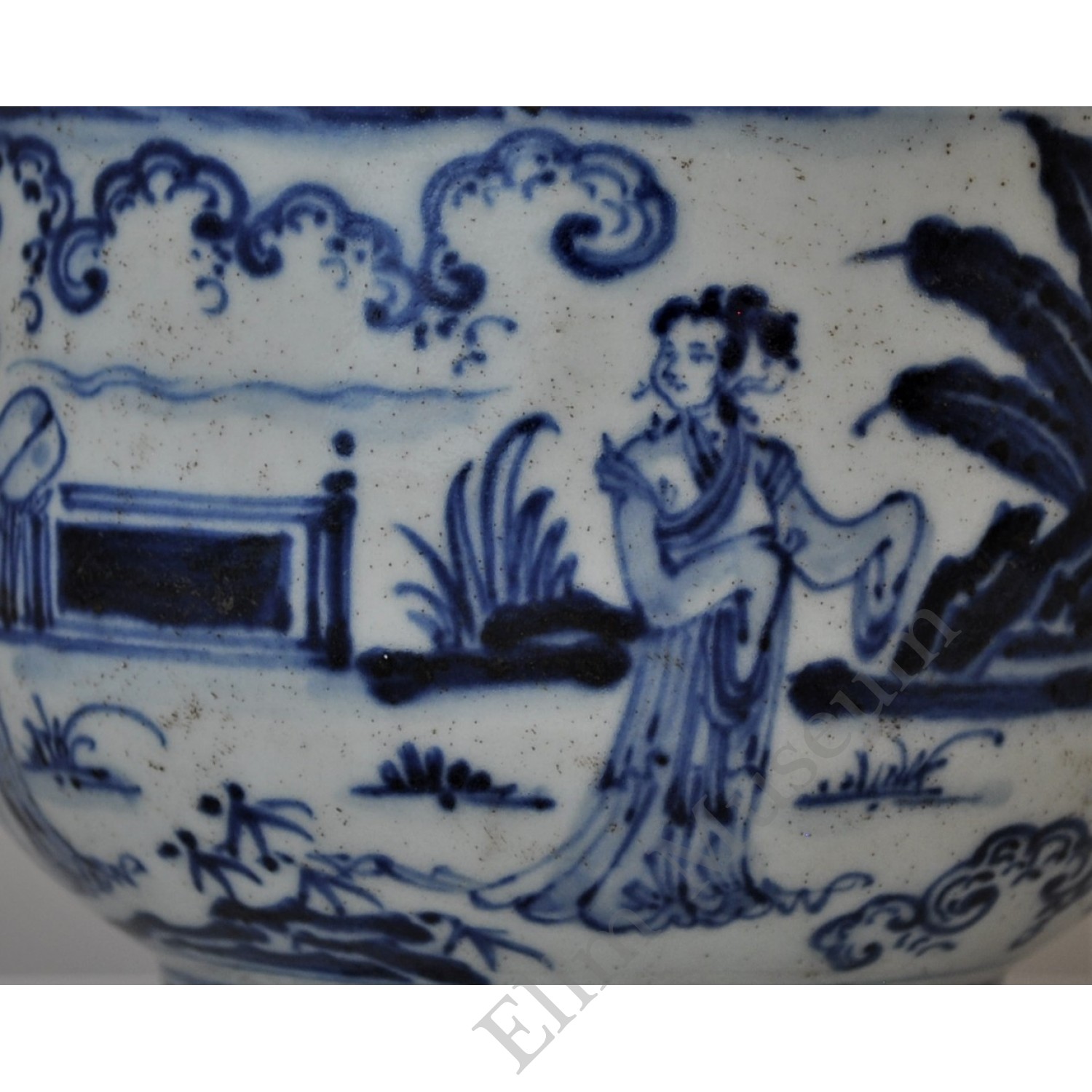
This bell-shaped blue-and-white bowl, bearing the mark “Made in the Xuande Reign of the Great Ming,” depicts three women in a garden in a continuous scene encircling its exterior. Balustrades, pavilions, and ornamental rocks define a secluded setting, with spreading banana leaves and drifting clouds. The women wear their hair in high coiffures and long skirts that trail to the ground. One holds an elongated object horizontally in both hands, apparently carrying a qin; another stands holding a fan. Beside the banana plant, a third woman turns her head and raises a hand, as though greeting or conversing with her companions. Their relaxed, mutually responsive poses evoke a life of refined leisure.
The cobalt decoration alternates between rich and pale tones, contrasting the dark banana leaves and rocks with the delicate folds of the women’s garments. Broad areas of undecorated porcelain lend the garden a sense of openness, while curling clouds introduce an ethereal quality into the everyday scene. Inside the bowl, pine, bamboo, plum blossom, orchids, lingzhi fungi, and rocks echo the garden on the exterior. A band of key-fret ornament around the foot provides an orderly boundary to the flowing composition. The vessel is painted with the characteristic imported cobalt pigment known as “Sumali blue,” producing particularly striking contrasts between deep and light shades.
Figural subjects were rarely seen in porcelain painting during the Hongwu and Yongle reigns. Only in the Xuande period did this situation begin to change, as imperial-kiln porcelains depicting court life gradually appeared. This bell-shaped blue-and-white bowl is a representative example. Such works generally remain removed from the realities of wider society, focusing instead on the leisurely, elegant activities of imperial family members and palace women within the palace walls: admiring the moon, composing poetry, playing the qin, or drinking tea. Their imagery emphasizes poetic refinement and an air of detachment from worldly concerns. The forceful porcelain paintings of the late Yuan period, with their vividly individual figures and dramatic tension, would not be seen again for a long time.
This change was closely connected with the stringent legal prohibitions of the Ming dynasty. During the Hongwu reign, the court issued decrees strictly restricting the use of images depicting ancient emperors, empresses, imperial consorts, sages, and worthies, as well as stories concerning them, on the utensils and clothing of officials and commoners. Laws governing theatrical performance also prohibited the portrayal of certain figures vested with political or ritual authority. At the same time, however, exemptions were made for subjects involving filial sons, obedient descendants, righteous husbands, chaste wives, and the encouragement of virtuous conduct, leaving room for such themes to be represented. As a result, the subject matter of figural art shifted away from the fate of the nation, social conflict, and human experience in times of upheaval, toward imperial and aristocratic life, garden pleasures, and poetic refinement—subjects that presented an idealized image of peace and prosperity.

With its delicate blue tones, this blue-and-white dish creates a striking contrast between two scenes on its interior and exterior. At the center, pavilions, balustrades, upturned eaves, pine trees, plantain leaves, and hanging palace curtains form a quiet yet splendid palace garden. A child in dark robes sits alone before the steps, his lips pouting and his eyes wide open, gazing forlornly toward the lower right. Another child of a similar age passes beside him with cold indifference. Although the two are close at hand, their eyes do not visibly meet. They seem to know one another, yet convey a sense of being worlds apart despite their physical proximity.
In contrast, the children on the dish’s exterior hold various musical instruments, including nao and bo cymbals and drums, playing music and dancing with joyful abandon, as though celebrating the Lantern Festival. Through delicate blue tones with subtle variations in intensity, spacious areas left unpainted, and distinctive individual poses, the painter brings stillness and bustle, solitude and joy together on a single vessel. The exuberance outside the palace walls stands in sharp contrast to the coldness and loneliness within.
This is a blue-and-white work whose meaning is elusive and difficult to decipher. To grasp the artist’s intention precisely is undoubtedly challenging. Yet one painful episode in the life of the Chenghua Emperor, Zhu Jianshen, may offer a key to understanding it: at about five years of age, he was stripped of his position as crown prince by his uncle, the Jingtai Emperor, Zhu Qiyu, and replaced by his cousin Zhu Jianji, who was close to him in age. The child seated alone on the raised steps is himself as a boy; the slightly older child passing by below with indifference is his cousin, Zhu Jianji.
Although he later became emperor, this childhood experience, filled with fear and uncertainty, may already have left an indelible mark on his memory. Viewed from this perspective, the estrangement between the two children in the painting seems to echo the predicament of Zhu Jianshen and Zhu Jianji: related by blood, yet like strangers to one another. However lively and noisy the world outside might have been, he may have found it difficult to confide his inner loneliness and fear to anyone. If he participated in conceiving the painted design for this porcelain dish, might he, consciously or unconsciously, have left within the scene these childhood memories of loneliness and helplessness?
Read the complete description and historical interpretation.
/DSC_0743-1500x1500-product_popup.jpg)
Thematic Interpretation: “Hongzhi Remembering His Mother” (Provisional Title)
This blue-and-white vase presents an enigmatic narrative through two palace scenes that are separate yet interconnected. On one side, a crowned man with delicate features sits upright before a screen, his hands tucked into his sleeves and folded below his abdomen. Smiling gently, he gazes slightly to his left, his composed posture suggesting that he is awaiting someone’s arrival. Beyond his line of sight, a woman approaches, escorted by a man who appears to be a servant. The servant respectfully extends both hands as he leads the way. This seems to be a previously arranged meeting, perhaps concerning a matter of importance to both parties. What they are about to discuss, however, is likely not a great affair concerning the rise or fall of the state, but a private romantic relationship.
Read the complete description and historical interpretation.

From the beginning of the Ming dynasty until the Jiajing and Wanli reigns, porcelain paintings depicting mounted warriors engaged in battle remain difficult to find. Dragons, phoenixes, flowers, auspicious animals, and other symbolic motifs were common on wares from both imperial and commercial kilns, while surviving examples with narrative figure scenes are relatively scarce. This situation gradually began to change during the Jiajing and Wanli periods.
During the Jiajing and Wanli reigns, scenes of mounted warriors in battle reappear on surviving porcelains. An imperial porcelain order from the twentieth year of Wanli explicitly lists wucai wares decorated with narrative figure scenes, indicating the attention given to such subjects in porcelain production for the court. The Bowl with Battle Scene in the Metropolitan Museum of Art, New York (accession no. 17.146.2), dated by the museum to the mid-sixteenth century, provides a surviving example of battle imagery on porcelain from this period. Its figures, warhorses, banners, and rocky landscape form a narrative battle scene with notable affinities to the wucai general jar in our collection. Particularly striking are the similarities in the mounted warriors, red pointed helmets and outward-projecting helmet ornaments, the linear rendering of armor, and the combination of red and green enamels.
According to modern ceramic scholarship, the distinctive general jar form first appeared during the Jiajing and Wanli reigns. This wucai general jar in our collection brings together armored riders, galloping warhorses, and clashing weapons to convey the courage and martial vigor of soldiers confronting the enemy. Its broad, rounded body provides ample space for a battle scene, allowing the figures, horses, and surrounding landscape to unfold continuously around the vessel.
Considered in the context of the major foreign campaigns of the Wanli reign, this imagery naturally brings to mind the Ming intervention in Korea against the Japanese invasions, particularly the victory at Pyongyang in the twenty-first year of Wanli (1593). The imperial court attached great importance to this victory. Volume 276 of the Veritable Records of Emperor Shenzong records that, in connection with military achievements at Pyongyang and elsewhere, the emperor called for victory to be reported at the ancestral temple and formally proclaimed, with promotions and rewards granted according to merit. This demonstrates the Wanli Emperor’s intention to publicize military success and affirm his martial achievements through formal ritual.
Could this wucai general jar, then, have been specially commissioned by the court to commemorate the victory at Pyongyang? Might its maker have used the image of mounted warriors in combat to celebrate the achievements of soldiers resisting invasion, affirm the ruler’s prestige, and express the hope that warfare would be quelled and peace restored throughout the realm? This possibility merits investigation. Although no direct commissioning record or inscription on the vessel currently confirms it, the form, figural imagery, and historical context offer clues for further exploration of this interpretation.

Among the wares listed for production at the imperial kilns during the Wanli reign, those depicting “All Nations Coming to Court” constitute one of the most distinctive categories. The Taoshu (Book of Ceramics), published in 1597, includes the phrase “萬古長春四海來朝面龍四季花人物” under the heading “Blue-and-White Ceramics on a White Ground Produced during the Wanli Reign.” This indicates that, by that year at the latest, the subject had already become a popular decorative theme on ceramics circulating in the market.
Such wares clearly carried a celebratory message: envoys from distant lands arriving to pay homage and present gifts highlighted the emperor’s wisdom and greatness, as well as the nation’s strength and prosperity. This wucai meiping vase, bearing the mark “Da Ming Wanli Nian Zhi” (“Made during the Wanli Reign of the Great Ming”), may well be a particularly representative example.
Its small mouth, short neck, broad shoulders, rounded body, and tapering lower section are characteristic of meiping vases of the Wanli period. Its most remarkable feature, however, is its documentary-style portrayal of a group of Europeans visiting China for the first time—a scene that may be exceptionally rare in the history of Chinese porcelain painting. Judging from their clothing and facial features, they appear to be white Europeans, possibly including secular figures of relatively high social standing, merchants, and Catholic missionaries.
The figures have large eyes, prominent noses, and narrow, pointed chins, conveying distinctly Western features as interpreted by the painter. They wear square caps or round, broad-brimmed hats, white or yellow ruffled collars, and brightly colored long garments, robes, and cloaks, with close-fitting stockings covering their lower legs. Together, these details create a striking foreign appearance, quite distinct from traditional Chinese dress, while offering clues to the figures’ identities and historical context.
The sailing ship displays several features characteristic of sixteenth-century European galleons: a relatively low bow, a high stern, a squared sterncastle, and three tall masts positioned forward, amidships, and aft. The painter’s attention to the vessel’s details is particularly striking. In addition to its tiered decks and rows of gunports along the hull, the scene includes what appears to be cannon fire, lending movement and vitality to this ocean-going vessel. These details suggest that the painter may have personally seen this distinctive type of ship, used for both commerce and warfare.
This meiping vase may well have been an imperial commission made at the command of the Wanli emperor. At the center of the composition, a phoenix spreads its wings, evoking the auspicious idea of “the phoenix arriving in majesty” and symbolizing a virtuous ruler, a realm united in allegiance, and visitors from distant lands coming to court. Although the work may have been intended to praise the emperor’s civil and military achievements, the painter employed an almost eyewitness documentary approach, carefully depicting the Westerners’ faces and clothing and the structure of their ocean-going ship. The result is a vivid portrayal of early exchanges between late Ming China, Europe, and the Catholic world. The vase may thus convey the political ideal of “All Nations Coming to Court” while also presenting the Western world as seen through Chinese eyes at the time: openness and exchange, in any era, can bring benefits to both sides.
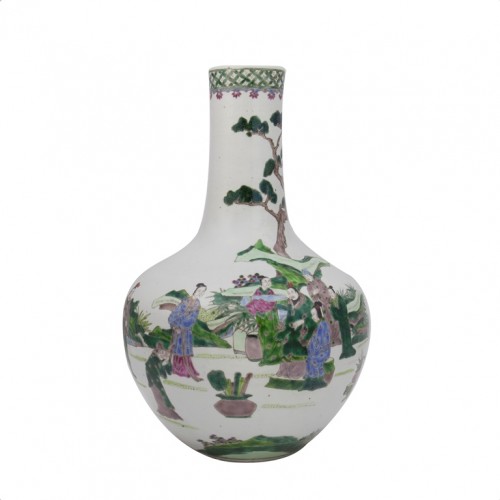
Selling Relief Grain in Chenzhou originated as a Yuan-dynasty zaju play of the thirteenth to fourteenth centuries. Originally entitled Bao the Court Attendant Oversees the Sale of Grain in Chenzhou, it was included in Selected Yuan Plays, published during the Wanli reign of the Ming dynasty. Set in the Northern Song dynasty, the play tells of a drought in Chenzhou. Liu Dezhong and Yang Jinwu—the son and son-in-law of the powerful Liu Yanei—are sent by imperial order to open the granaries and sell relief grain. Instead, they exploit the relief operation for personal gain, raising grain prices and cheating the people with undersized grain measures and overweight scales. They also kill Old Zhang, who has come to buy grain, with an imperially bestowed purple-gold hammer. His son, Xiao Piegu, travels to the capital to seek justice and encounters Bao Zheng. Commissioned by the emperor to investigate, Bao uncovers the truth in disguise, punishes the corrupt officials, and secures justice for the people.
The two narrative scenes on this wucai vase may be read as episodes from Acts Three and Four of the play. In the first, Bao Zheng disguises himself as an elderly farmer to investigate incognito, only to be strung up in an old scholar tree by Liu Dezhong and Yang Jinwu at the Official Reception Pavilion. The second depicts a confrontation in the Chenzhou government courtroom: after ordering Liu Dezhong's execution and allowing Xiao Piegu to kill Yang Jinwu with a melon-shaped mace, Bao faces Liu Yanei, who arrives bearing an imperial decree intended to save his son and son-in-law.
The painted decoration includes numerous objects and figures closely associated with the plot: the old scholar tree, the melon-shaped mace, Bao Zheng's imperial sword of authority, documents and registers, and an imperial decree. The figures may be identified as a white-faced Bao Zheng, his four personal guards, the plaintiff Xiao Piegu, the courtesan Wang Fenlian appearing as a witness, and Liu Yanei holding the imperial decree. These mutually reinforcing details provide clues for interpreting the scenes through the story of Selling Relief Grain in Chenzhou.
Works celebrating upright officials who punish corruption and protect the people are plentiful in traditional Chinese literature and drama. Stories and plays centered on Bao Zheng were particularly widespread. Porcelain decorated with such subjects, however, is less commonly encountered. Two features of this vase are especially noteworthy. First, Bao appears with a white face, possibly reflecting the episode in which he investigates in disguise. Second, the sword symbolizing his imperially granted authority is a prominent prop. These features differ from the familiar later image of the black-faced Judge Bao and his dragon-headed execution device, and may preserve certain characteristics of early Yuan-dynasty Bao plays.
Made in the early Qing dynasty, the vase's choice of subject may be understood against the gradual restoration of social order and the court's advocacy of administrative reform during the Kangxi reign. It may also reflect the people's shared hopes, after the warfare accompanying the dynastic transition, for an enlightened sovereign, honest officials, and a peaceful, secure livelihood.
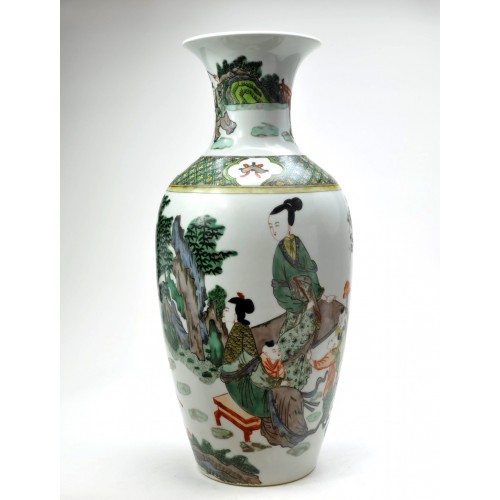
Interpreting this famille-verte vase depicting ladies in a garden is no easy task. Every figure and object in the scene seems to carry powerful symbolic and suggestive meanings. Such a carefully conceived composition is exceptionally rare in Chinese porcelain painting and may be regarded as a remarkably forward-looking work. Its subject may be connected with the strategy pursued by the Manchu rulers in the early Qing dynasty to win over the remnants of the former Ming imperial clan.
At the center of the scene, three noblewomen sit elevated above the others, occupying the position of hosts. Their expressions are difficult to read: some appear haughty, others compassionate, while their faint smiles seem to conceal their true thoughts. Below them, relegated to the position of guest, sits a woman in profile, visibly uneasy, with a timid young boy beside her. The woman wears a yellow sleeveless vest decorated with dragon-scale patterns, while the boy is dressed in traditional Han Chinese clothing with a Y-shaped overlapping collar. These details of dress seem to suggest that mother and son possess both Han Chinese ancestry and the status of descendants of the Ming imperial aristocracy.
By contrast, the collars worn by the three hostesses and the children beside them are mostly reversed, forming an inverted Y shape. This creates a striking contrast with the clothing of the visiting mother and son. If this difference is understood as a deliberate ethnic marker devised by the painter, the three hostesses may be identified as Manchu noblewomen. Looking down at the visiting woman with narrowed eyes, they seem to assume the posture of victors scrutinizing a consort of the former dynasty. Might the three noblewomen standing together also allude to the transfer of power across three generations—from Hong Taiji to the Shunzhi Emperor and then the Kangxi Emperor?
The game being played by the hosts and guests is touhu, or arrow pitching into a vessel, a pastime long popular among the traditional upper classes. Yet the visiting woman and child in the painting have nothing in their hands and no arrows left to throw; three arrows have already been cast, two of them missing their mark. Their opponents, by contrast, still hold arrows in hand, ready to take their turns. This stark imbalance in the contest may suggest that the Ming dynasty’s fortunes had been exhausted and its defeat had already become inevitable.
Part of the woman’s face is obscured by a garden rock, as though she has literally encountered a wall. This also evokes the predicament of having nowhere left to turn. At this moment, a boy with a slightly raised chin, narrowed eyes, and an air of youthful arrogance appears to be inviting the little “prince” beside her to join his side. Although the child still seems hesitant, his expression appears to reveal the first signs of temptation.
The painter has also cleverly placed a plump, richly dressed boy behind the inviter, holding a lotus flower aloft. In this narrative context, the Chinese word for “lotus,” lian, is homophonous with the word meaning “to connect” or “continuously,” and may be understood as an allusion to repeated advancement and rising success. If the descendants of the former dynasty were willing to change allegiance and become what might be called people who “recognize the times,” a path toward wealth, honor, and prosperity might open before them. Thus, what appears to be an ordinary game of touhu in a garden may in fact embody the difficult choice faced by the remnants of the Ming imperial clan during the dynastic transition—caught between dignity, belonging, and the lure of practical rewards.
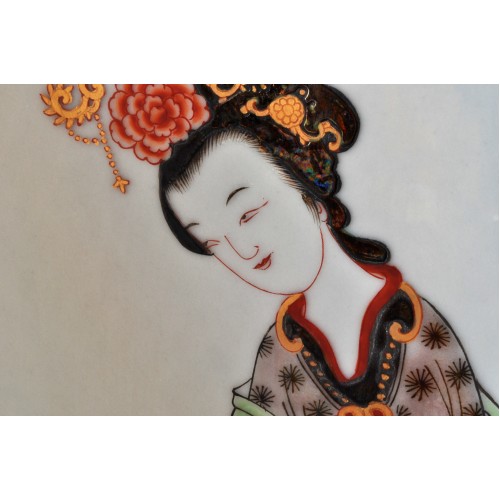
This large square wucai vase has a flared mouth, a long neck, and flat shoulders above a tall, angular body. The rounded neck contrasts harmoniously with the sharply defined edges of the body. Its four sides resemble four upright painted screens, each depicting an elaborately dressed lady. The figures and the objects they hold evoke the Four Arts—qin music, weiqi, calligraphy, and painting—bringing refined cultural interests into the vase’s sumptuous decoration.
The ladies wear their hair in high coiffures adorned with flowers and gilt ornaments. Their wide-sleeved robes are complemented by flowing shawls and trailing sashes. Some incline their heads in contemplation, while others glance sideways with faint smiles; their slender fingers and poised gestures convey an unhurried elegance. Fine, assured lines delineate their brows, eyes, noses, and lips, while individual strands of hair are carefully rendered along the temples. The restrained treatment of their faces contrasts with the intricate patterns of their hair ornaments and garments, lending the figures a delicate yet lively presence. One lady cradles a qin in its brocade case, while another holds an exquisitely decorated book case, giving visible form to the ideal of cultivated accomplishment.
Red, green, yellow, blue, and purplish brown are combined throughout the decoration. Black coiffures and garment borders add depth, while touches of gilding enhance the sense of luxury. Lotus blossoms, chrysanthemums, flowering branches, and perforated garden rocks surround the figures, suggesting a secluded and elegant garden. Flowers and butterflies decorate the neck, while a finely patterned diaper ground on the shoulder sets off floral motifs and scholarly objects. These densely ornamented areas are balanced by the generous white ground of the body, creating richness without overcrowding.
During his reign, the Kangxi emperor pursued policies of harmony between Manchu and Han Chinese and of social and economic recovery. He placed particular emphasis on government through virtue, believing that governing a country required not only laws but also the cultivation of moral character and personal refinement among the people. The Four Arts symbolize the cultivation of traditional Han Chinese literati and can also express women’s talents and intellectual lives. The theme thus accords with the Kangxi court’s broader strategy of engaging Han Chinese society and advocating virtuous government. By embodying the Four Arts in four female figures, this work directs attention beyond beauty and dress to the knowledge, taste, and talent they represent. Each panel stands independently, yet the four connect as the vase is turned, together creating an ideal world in which flowers, cultivated accomplishment, and beauty coexist.
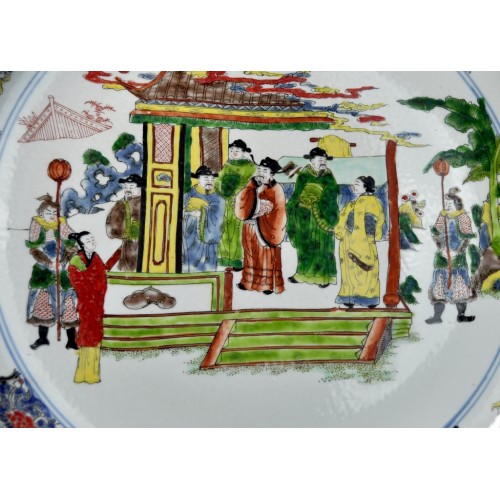
This large Kangxi-period wucai dish, approximately forty-five centimetres in diameter, depicts a judicial scene that may involve imperial authority. Underglaze-blue concentric lines divide the decoration around the rim into bands, where red blossoms and green foliage alternate with diaper-patterned panels and miscellaneous auspicious emblems, framing the narrative at the centre. Red, green, yellow, blue, and brown create a vivid palette. The hall, columns, balustrades, and steps establish a clearly articulated space, directing the viewer’s attention to the subtle interactions between the officials above and the woman below.
Several figures in official robes of different colours gather in the hall. Some turn to converse, while others exchange smiling glances, their demeanour notably relaxed. At the centre stands an official in a reddish-brown robe, one hand resting on his belt and the other stroking his beard. His composed expression suggests that he has already formed a confident judgment about the case before him. Guards holding long-handled ceremonial maces stand on either side, lending the scene a solemn, ceremonial atmosphere. With economical yet fine, assured lines, the painter delineates brows, eyes, beards, and gestures, giving each figure a distinct personality despite their similar official attire.
In striking contrast to those in the hall is the woman in red at the lower left, outside the steps. Standing beside a guard, she appears to be a party to the case who has been brought before the officials to await questioning or judgment. Her arms are folded across her chest, her lips tightly closed, and her gaze directed sideways and upward toward the hall. Her expression combines wariness and tension with a measure of pride and defiance. She neither bows her head to beg for mercy nor shows any sign of submission. Her vivid red clothing and isolated position make her an especially arresting presence within the composition.
Particularly noteworthy are the multicoloured auspicious clouds drifting above the hall and a yellow textile, possibly a dragon robe, draped over the back of the central chair. What appears to be the outline of a collar can be discerned along its upper edge. Placed in such a prominent position, this robe, together with the clouds, officials, and mace-bearing guards, may suggest that the crown prince—or even the emperor himself—had taken part in the proceedings.
We cannot yet determine whether the scene depicted on this dish relates to a specific case from the Qing dynasty. What is remarkable is that the artist’s perceptive observation and subtle portrayal of the figures’ circumstances lend the work something of the character of “critical realism.” On the one hand, it presents imperial majesty and the ideal of impartial judgment; on the other, the red-robed woman’s refusal to yield readily preserves a sense of individual dignity and resolve in the face of authority. The scene also prompts a troubling reflection: without imperial intervention, how many injustices suffered by ordinary people might have remained forever unredressed?
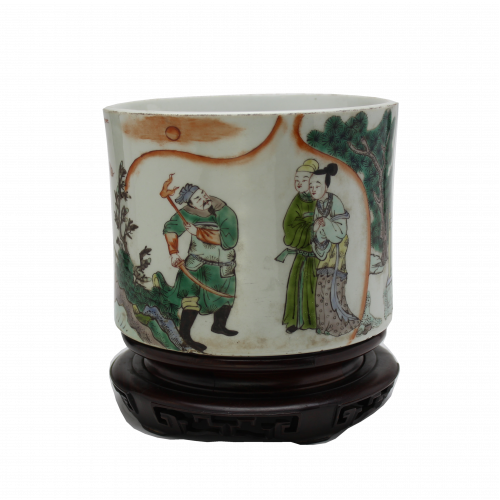
The ingenuity of this wucai brush pot, bearing the reign mark “Made during the Kangxi reign of the Great Qing,” lies in its simultaneous portrayal of a person's dream and waking reality. In a continuous composition encircling the vessel, the painter connects solitary sleep by candlelight, a reunion in a dream, and the approach of an armed intruder. An everyday scholar's object thus becomes a narrative space filled with longing, fear, and human conflict.
On one side, a scholar in a green robe sits at a desk, his cheek resting on one hand and his eyes gently closed in sleep. An open book, brushes, and an inkstone lie before him, while a candle continues to burn. The screen and window frames behind him, together with the railing in front of the desk, enclose a quiet interior. Rather than showing the turmoil of his awakening, the painter preserves his sleeping posture, allowing viewers first to encounter his solitude and then, as they turn the vessel, to enter the story unfolding in his mind.
On the other side, a winding, reddish-brown contour resembling cloud vapour separates the dream from the surrounding trees and rocks. Within it, the scholar and a young woman stand close together. Her hands are gathered at her chest, and he stands immediately behind her; their intimate poses suggest a recent reunion and a reluctance to part. Yet a bearded intruder wearing a headcloth has already approached them. Holding a torch in one hand and a curved blade in the other, he stands with his legs apart and turns to stare at the couple. The scene is suspended at the moment before tenderness is interrupted by violence. Their closely joined figures contrast sharply with the threatening blade and flame, making the happiness of the dream seem especially fragile.
This sequence—a scholar falling asleep, a reunion with his beloved, and the approach of an armed figure—corresponds to the “Dream at the Grass Bridge Inn” episode in Act Four of Book Four of Wang Shifu's The Romance of the Western Chamber. In the play, Yingying's mother makes success in the imperial examinations a condition of marriage, obliging Zhang Sheng to leave Cui Yingying and travel to the capital. While staying at the Grass Bridge Inn, he dreams that she has slipped away from her household and come alone to join him on his journey. No sooner are they reunited than soldiers carrying torches pursue her and seize her, startling Zhang Sheng awake. The painter condenses this dramatic sequence into a few interconnected images, enabling viewers to feel the tension between reunion and separation without reading the play's lyrics.
What makes the work particularly moving is that, although the dream is imaginary, its fear is rooted in reality. By day, the demands of official success and marriage force Zhang Sheng to travel far from his beloved; by night, he experiences the terror of losing her again in a dream. Separation in waking life and abduction in sleep thus echo one another. Read in this way, the armed intruder is more than a character advancing the plot: he may also symbolize the external forces that obstruct sincere affection and govern individual lives. Through the dream, the painter gives visible form to anxieties that are difficult to express, turning a romance of a scholar and a beauty into a reflection on the constraints of family status, official ambition, and marriage.
Artistically, the orderly lines of the interior architecture play against the flowing contour of the dream, while the sleeper's stillness contrasts with the armed figure's menace. Green enamels spread across robes and pine foliage; red accents mark the candle flame, the torch, and the dream's outline; yellow, blue, and brown are interwoven throughout. The painting holds both the quiet of a scholar's room at night and the unease of an impending nightmare. Its composition transcends ordinary time and space to convey deeply recognizable human feelings. Its critical force lies in prompting viewers to consider how oppressive the forces separating the lovers in waking life must be, when even their reunion in a dream cannot remain secure.
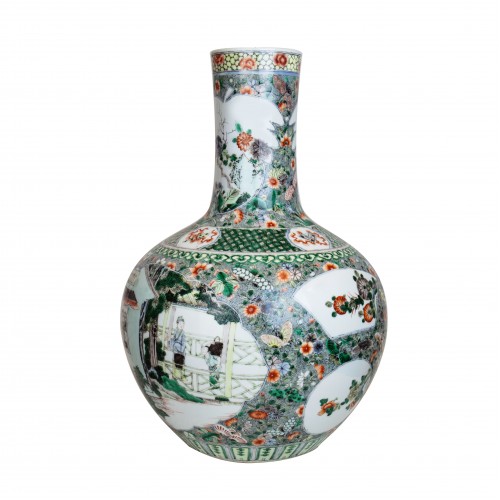
This large wucai globular vase has a tall, upright neck and a rounded body, giving it an imposing yet balanced form. Flowers, butterflies, diaper patterns, and auspicious motifs form a dense decorative ground, while reserved panels around the body depict scenes of sericulture. Brilliant colours complement the unassuming activities of daily life, placing silkworm rearing and cocoon gathering at the heart of the vessel's narrative.
Following the collection's existing interpretation, the four figure scenes may be read counterclockwise as stages of “mature silkworms,” “gathering cocoons,” “sorting cocoons,” and “placing them in storage.” They relate to the sericultural processes described in the “Naifu” (“Clothing”) chapter of Song Yingxing's Tiangong Kaiwu (The Exploitation of the Works of Nature). “Mature silkworms” refers to the stage when the worms are ready to spin their cocoons. Comparison with the accompanying woodblock illustrations reveals notable correspondences in courtyard walls, doors and windows, sericultural equipment, and the arrangement of figures passing objects or working together. In particular, the placement of figures and the courtyard layout in the “mature silkworms” scene are closely related, suggesting that the painter may have drawn upon such imagery, adapting and rearranging it to suit the vessel's curved surface and the shapes of its panels.
The figures bend to inspect their work, reach to lift objects, or carry baskets, their movements unfolding naturally around the tasks of sericulture. Houses, railings, and courtyard trees connect the different work areas, presenting an ordered domestic life sustained by cooperation. Some figures smile and exchange glances, lending the busy scenes a sense of pleasure in the approaching harvest. Beyond recording practical procedures, the painter conveys anticipation of the rewards of labour and the reassurance of having food and clothing provided for.
The subject accords with the Kangxi emperor's emphasis on agriculture and sericulture as foundations of good government. In his Essay on Agriculture and Sericulture, he wrote: “Farming provides food; sericulture provides clothing. Harm to farming is a source of hunger; the abandonment of women's textile work is a source of cold.” In this view, cultivation and silk production meet people's most basic needs and underpin social stability. The vase's scenes can therefore be understood within a broader concern for encouraging productive work and sustaining livelihoods: sumptuous fabrics depend on painstaking, continuous labour, and seemingly ordinary household production is closely connected with the governance of the state.
The ornament is equally inventive. Beyond the figure panels, red, green, yellow, blue, and purplish-brown enamels interweave among overlapping flowers and foliage, with butterflies and moths passing between them. Fan-shaped and other irregular floral reserves punctuate the surface. The dense coloured ground contrasts with the more open white spaces within the panels, allowing the narrative scenes to remain clearly legible amid the rich decoration. Diaper patterns at the shoulder, a ruyi-shaped border, and a band of upright motifs near the foot organize the decorative layers and give the vessel a unified appearance.
Particularly striking are the fine black dots filling the spaces between the flowers and leaves. Their texture resembles a fish-roe ground and sets off the crisp outlines of blossoms and winged insects. Viewed in relation to the sericultural subject, some of the butterflies and moths may evoke silk moths emerging from their cocoons, while the dense stippling may invite further associations with silkworm eggs and the renewal of life. These possible meanings connect the surrounding ornament with the figures' work. The vase brings together knowledge of sericulture, the beauty of labour, and agrarian ideals in richly coloured porcelain painting, giving a grand display vessel an enduring concern with everyday livelihoods.
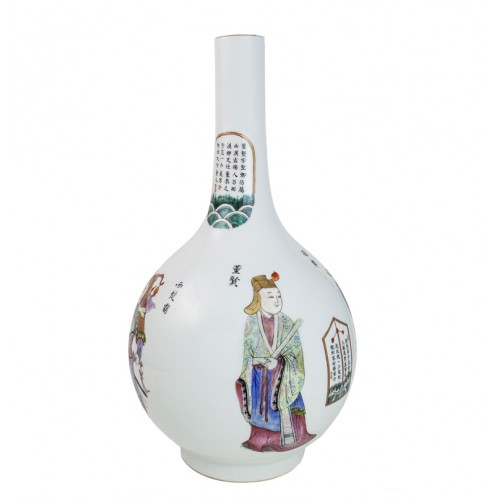
The Wushuangpu (Table of Peerless Heroes) is a collection of biographies of notable figures from Chinese history, bringing together poetry, calligraphy, and painting. Published during the Kangxi reign, it presents forty men and women celebrated as peerless heroes or legendary figures, spanning approximately fifteen centuries of Chinese history.
Read the complete description and historical interpretation.