

Item No.: 1632
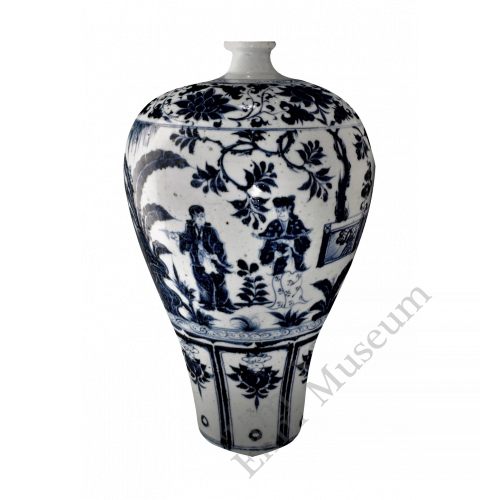
Name: A Narrative Scene from Jinxiangting on Yuan Blue-and-White Porcelain
Period: Yuan dynasty
Size: 44.2 cm
The Yuan-dynasty play Meng Yuemei Writes of Her Grief at the Brocade Fragrance Pavilion tells the story of the scholar Chen Gui and Meng Yuemei during the Tianbao era of Emperor Xuanzong of the Tang dynasty. They meet and fall in love, but the An Lushan Rebellion forces them apart. After many trials and hardships, the husband and wife are finally reunited. The Yuan blue-and-white porcelains depicting Jinxiangting that are currently seen on the market are all based on this plot. Their painters, however, conceived their compositions from the traditional perspective of “a talented scholar meeting a beautiful woman.” Most scenes therefore derive from the play’s opening episode: Chen Gui and Meng Yuemei meet by chance at the Brocade Fragrance Pavilion, fall in love at first sight, and privately pledge themselves to one another.
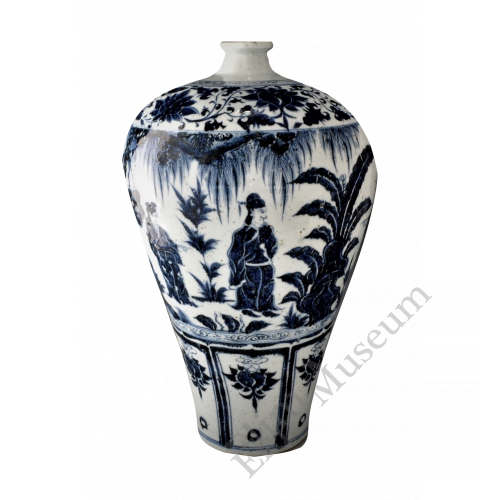
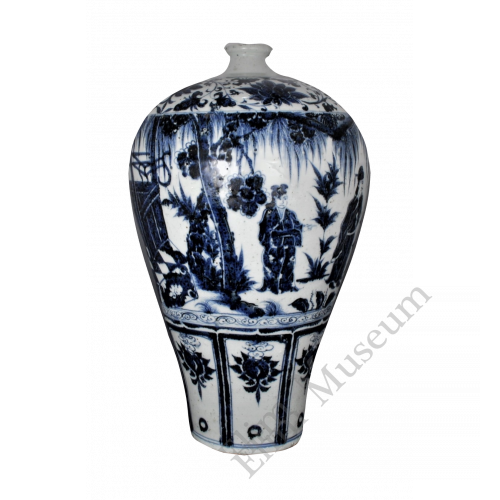
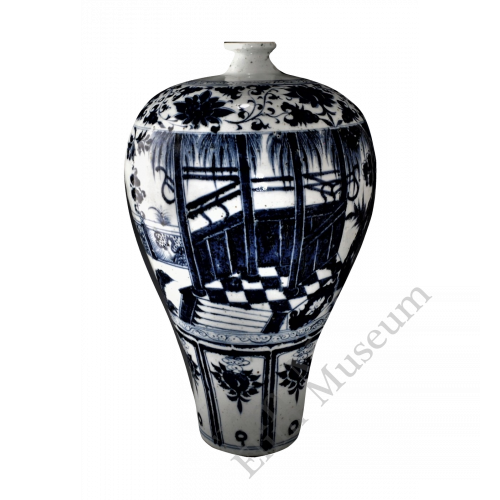
This Yuan blue-and-white meiping vase depicting Jinxiangting, however, departs from that conventional formula. Instead, it portrays the moving final episode of the drama: after more than ten years of painful separation and hardship, the two protagonists meet again at the Brocade Fragrance Pavilion, with the help of the celebrated general Guo Ziyi.
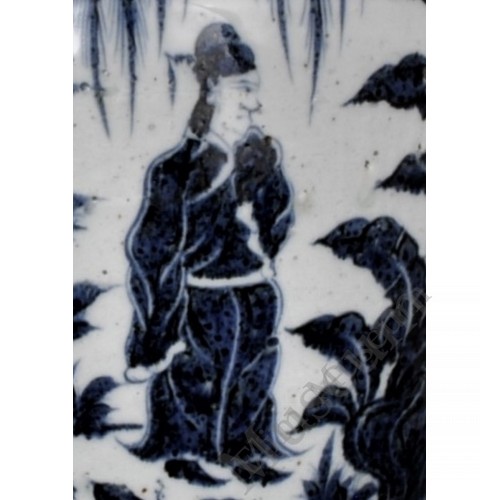
The man in the painting wears a tall headdress, a long robe, and a broad belt. His refined features and composed expression suggest a man in his prime who holds official rank. Behind him follows a young attendant, reverently holding in both hands a square object with four clearly defined corners. Its regular shape and the attendant’s respectful bearing suggest that it may well be an official seal or a box containing one. This is an important detail through which the painter hints at the figure’s identity, official position, and achievements in public service.
From these observations, we may infer that the man is Chen Gui, the story’s male protagonist. He is no longer the young scholar who first met Meng Yuemei, but a man who has achieved distinction, attained official rank, and returned home in honor.
The woman in the painting likewise seems no longer to be the young maiden who first encountered Chen Gui. Her face is full and rounded, her eyes and brows serene, her hair arranged in a high coiffure, and her clothing dignified. She conveys the presence of a mature woman, perhaps even one entering middle age. Her appearance and expression seem to bear traces of passing years and lived experience. Her image complements that of Chen Gui returning in triumph, bringing to mind a husband and wife who have endured the anguish of separation and the vicissitudes of life, only to be reunited at last.
Notably, the painter does not dramatize this long-awaited reunion through exaggerated gestures or intense displays of emotion. Instead, the figures’ restrained expressions and composed movements, together with the surrounding garden scenery, create a tranquil, poetic atmosphere. This understated yet richly narrative approach gives their inner feelings a deeper and more thought-provoking artistic power.
An intriguing question remains: what message was the artist seeking to convey through this episode? If we place the work against the historical background of the Red Turban uprisings in the late Yuan period, the weakening rule of the Mongol dynasty, and profound upheaval in the social order, we have reason to propose a deeper interpretation. This is far more than a conventional romantic tale of a talented scholar meeting a beautiful woman; it may be a work imbued with a profound sense of devotion to family and country. The painter’s deliberate choice of Chen Gui’s triumphant return and the couple’s reunion, rather than simply their first encounter and romantic pledge, clearly carries a deeper significance.
In traditional Chinese Confucian thought, learning is not merely a means of obtaining personal fame, wealth, or official rank. It also embraces the ideal of “cultivating oneself, bringing harmony to the family, governing the state, and bringing peace to all under Heaven.” Chen Gui’s story can be understood as an artistic expression of this ideal: through years of diligent study, he achieves distinction; through establishing himself, he assumes social responsibility; and finally, by returning home in honor and reuniting with his wife, he fulfills his commitments to family and life.
We may even speculate further: the artist may very well have intended to use Chen Gui’s story to encourage Han Chinese intellectuals to join the Han Chinese armed forces resisting Yuan rule, participate actively in social change, put their learning and talents to use, achieve distinction through service, and help rebuild the national order. In this sense, the Jinxiangting narrative on this Yuan blue-and-white porcelain may be a work whose outward subject is romantic devotion, while its deeper meaning concerns devotion to family and country. It offers a promising avenue for further exploration of the historical consciousness and humanistic spirit embodied in late Yuan porcelain painting.